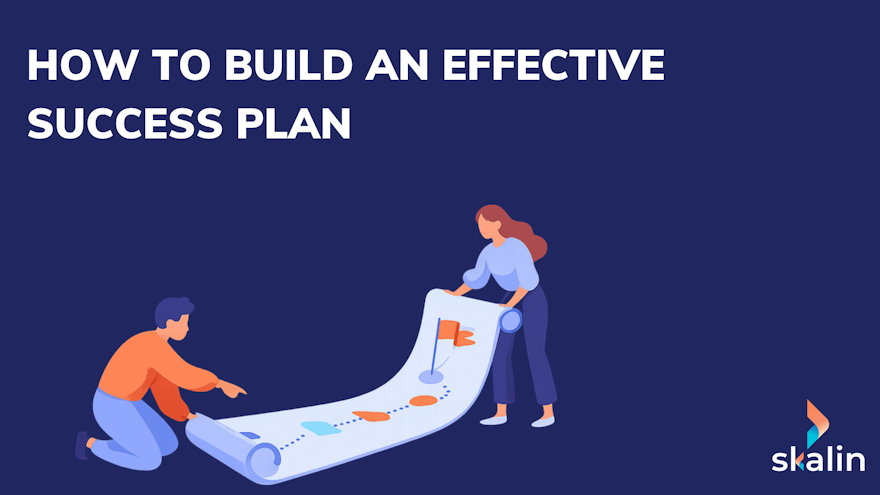
Your goal as a Customer Success Manager is to help your customers achieve their objectives with your product. The Customer Success Plan sets out those objectives, how they'll be measured and how to reach them (the "what" and the "how"). It's a series of actions designed to meet your customer's expectations.
Every SaaS company needs a Customer Success Plan to make sure customers successfully address the need or problem they came to you with. Because a customer who doesn't reach their goals is a churn risk in the making!
The Success Plan lets you track the steps that should lead your customer to success. Each step involves actions from every stakeholder: the document gives everyone clear objectives and lets you track progress.
A Success Plan should be realistic, measurable and achievable. It's a key tool for a CSM to align their resources, tasks, time and effort with the end goal. Let's look at how to build an effective Customer Success Plan.
Why create a Success Plan?
Consistency and aligned effort
A Success Plan keeps your customer's end goal front of mind at all times. That way, you have a clear line of action with your customers and avoid spreading yourself too thin. You take the right steps, each one bringing you a little closer to the goal, and you work more efficiently.
With a Success Plan, you're very likely to reach your goals (and so is your customer!) if you stick to the framework you've defined. It also helps you channel your customer's requests: was the request identified when the plan was built? Is it consistent with the target goal? If not, it'll be easier to explain to your customer why you're not taking it forward. If the request is relevant, on the other hand, you can include it and update your Success Plan by mutual agreement.
Better anticipation of customer risks
Clearly, putting out a fire takes more time and energy than smothering the embers. It's the same in Customer Success! A Success Plan helps you anticipate problems and put them in writing. You're better prepared and can deal with them more easily.
Better results and consistent processes
With a Customer Success Plan, the time you spend and your mental load are reduced considerably. You know what to do after each key milestone. Better still, you can reuse the process for future customers or for those of other team members. You build on your customers' success while making your processes increasingly consistent. Everyone wins!
How do you build your Success Plan?
Define what "success" means with your customer
A good plan starts by defining the customer's expectations. Without expectations, there's no workable plan. What do your customers expect from using your product? What made them sign up? Do they have pain points? What are their goals? What do they consider a success?
You need to help your customers express what they expect from your product right from the start. Even if some information was shared during pre-sales, the best time to uncover and confirm those expectations is still the onboarding phase. Through strategic conversations, you need to find out what they expect from you.
You then need to clarify which expectations are achievable and which aren't. At the same time, you should have a clear idea of your own expectations of customers (fast adoption, time to value, becoming an advocate...).
Once you've defined these elements, you need to define your ideal customer profile, along with several variants (based on your personas). Variants let you meet each type of customer's needs more precisely while following a defined framework (for example, if you sell a marketing solution, expectations won't be the same depending on whether you're talking to the acquisition team or the CRM team). This lets you offer a specific yet structured experience ("one-to-few").
Not sure what your customers expect from your product? Ask them! It can help you get an accurate picture of what your customers are looking for, so your actions are effective and well targeted.
Set out the steps that lead to the agreed goals
Once you've worked out what your customers expect from your product, you'll need to break it down into intermediate steps. This is the "how" of your plan. Let's go back to the earlier example: I sell a marketing solution, and my customer's ultimate goal is to grow revenue. How? You'll need to translate that into concrete steps that help your customer reach intermediate goals and get their first results with your platform (for example: 1. set up their first landing pages 2. segment their customer base 3. launch a first automated campaign...). This delivers quick wins and avoids the tunnel effect.
These processes can vary depending on how the customer wants to proceed. Some customers prefer to dive straight into using a product with minimal help, while others want hand-holding at every stage. Your plan is a framework, not a straitjacket. Adapt to your customer so you don't put them off, but stay on course!
Define the success KPIs
When you have measurable goals, you can objectively assess whether your customers are getting the best value for what they pay you. And you can do so at every stage of their journey. This helps reduce churn during the adoption phase.
You need to make sure the goals you set are measurable and actionable. By tracking goals regularly through precise KPIs, you can assess customers' future health and spot potential sticking points early. And take swift action where needed. That way you can catch problems before customers even notice them! Be proactive so you're no longer on the back foot.
Keep your own goals in sight
You also need to measure the progress of each of your CS processes, for example how long it takes your customer to complete onboarding. Having a target measure at each stage of your Success Plan helps you assess how effective your processes are. If you're behind your initial target, try to work out why. Build levers to address those causes into the next version of your Success Plan. Keep improving your processes through regular iterations.
Share a "light" version with the customer
You need to be transparent with your customer and not keep your Success Plan to yourself. At the very least, check in regularly to go over goals and deadlines. Ideally, create a lighter version of your Success Plan in a document shared with your customer (a "joint Success Plan"). This will get them more involved in the deadlines and the action points they own. It can be something simple: a one-pager or a shared Google Sheet.
Identify and assess risks
In your version of the document, list anything that could stop you reaching the agreed goals. Don't sweep them under the carpet: quite the opposite! List the potential risks and estimate how likely they are to happen. Your marketing solution requires a tracker to be deployed on the website and your customer's IT team is snowed under? Don't keep it to yourself. Writing it into the Success Plan keeps the issue front of mind, helps you find workarounds with your team and, once again, lets you plan ahead.
Run the Success Plan and keep it alive
The final step in creating a Customer Success Plan template is putting the plan into action. To do this well, you need to hold regular progress reviews with your customers, ask for their feedback and make sure they're on track to reach their goals. After each meeting, update the document and send a summary of the key points agreed. Follow these steps and you'll considerably reduce the risk of churn.
Keep a close eye on how your customers are progressing too, identify pain points and resolve problems before customers notice them. Give them advice so they succeed, because their success is your success. Once again, the Success Plan is a framework, a guide. It isn't a static document set in stone during onboarding. Keep it alive with your customers. A Success Plan that works is one the customer takes ownership of and actively drives. If you manage that, it won't feel like a constraint but will become the cornerstone of your customer relationship.
Further reading: