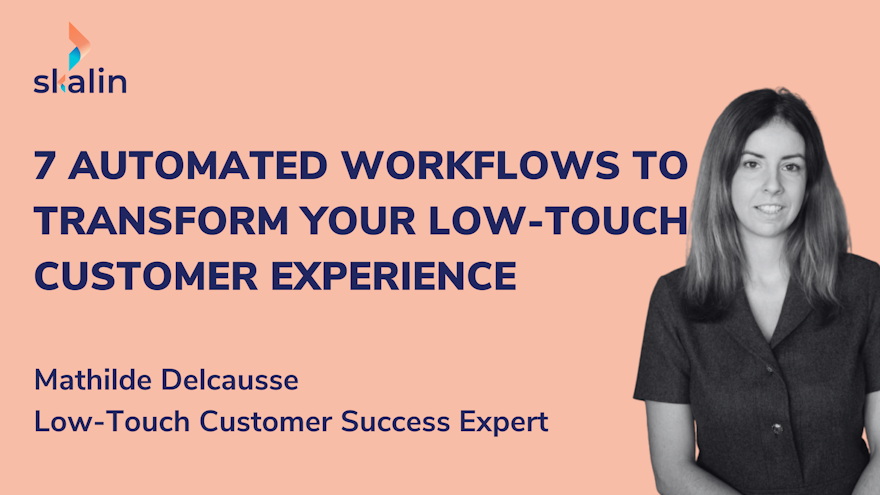
Customer Success teams are increasingly expected to manage very large portfolios, which makes process optimisation essential. In low-touch segments, where human contact is limited by design, automated workflows aren't a luxury. They're a strategic necessity.
Why? Because they help you:
- Save valuable time by automating low-value tasks
- Focus human effort on the moments that matter most in the customer relationship
- Prevent churn by spotting weak signals early
- Deliver a smooth, consistent and scalable customer experience
Here are 7 high-impact workflows to transform how you manage small accounts and get the most value from them.
#1. Automated Health Score: the thermometer for your portfolio
A well-designed Health Score is your best ally for making sure no at-risk customer slips through the net. With automated scoring based on behavioural and contractual data, you can prioritise your CSMs' actions objectively.
Tip: tailor your score to the specifics of your low-touch segment. For example, a customer who logs in fewer than 3 times a month may be perfectly normal in this segment but a warning sign in a high-touch one. Set the right alert thresholds, segment your rules and automate notifications to CSMs as soon as a customer drops below a critical threshold.
📌 Read | How Artificial Intelligence can help implement a customer Health Score.
#2. Automated onboarding and welcoming new users
Successful onboarding gets you halfway to customer success. And it isn't only about first contact: every new user who joins an existing account deserves a proper welcome.
Set up an automated sequence that:
- Sends a personalised welcome email
- Offers a guided journey or a key resource based on the user's role
- Captures their first impressions through a short survey
Benefit: you build engagement from the very first interactions while gathering valuable insights.
#3. Strategically timed satisfaction surveys
Surveys are only useful if they are:
- Targeted
- Relevant
- Quick to complete
Automate short surveys (5 to 8 questions) at key moments in the customer journey:
- After onboarding
- After a support ticket is resolved
- At the 6-month mark
- Ahead of the renewal date
💡 Tip: create several versions tailored to the recipient's role (contract signatory, end user, decision-maker). And use consistent metrics (e.g. a score out of 5) so results are easy to compare.
#4. Customer referral programme: tap into your base of advocates
Small accounts are often overlooked when it comes to advocacy strategy. Yet they are a valuable pool of satisfied customers who are ready to give a testimonial or recommend your product.
Set up a workflow that:
- Automatically identifies highly satisfied customers (based on survey responses)
- Sends an automated request to find out whether they'd be willing to recommend your solution
- Centralises their responses in an advocate database for Marketing, Sales and CS teams
Result: case studies, testimonials and reference calls ready to go whenever you need them to support growth.
#5. Product adoption: the right content at the right time
Low adoption isn't always down to a lack of training. Often, customers simply haven't yet seen the value of certain features.
Set up a workflow that:
- Triggers targeted content based on usage (video, testimonial, how-to article)
- Automatically sends a useful resource when a customer discovers a new feature
- Suggests use cases linked to their business goals or industry
Bonus: measure the impact of this content by tracking how often it's viewed in the product or through your emails.
#6. Re-engaging silent customers: stay connected without the effort
Silent customers are a real churn risk. Create a workflow that:
- Automatically identifies inactive customers (e.g. no login for 45 days)
- Sends a personalised email with useful resources
- Escalates to a human contact if there's no response after several follow-ups
💡 Tip: test different hooks for different profiles (curiosity, customer benefit, product news) to maximise your re-engagement rate.
#7. Smart internal alerts: your CSMs in the right place at the right time
There's no need to spend hours poring over dashboards. Set up automated alerts instead.
Useful alert types:
- Sudden drop in usage
- No login for X days
- Unused feature
Each CSM receives a notification in their CRM or via Slack. The result: faster response, fewer things slipping through the cracks and better-targeted actions.
Conclusion: automation in service of the customer relationship
Workflows don't replace people. They free up time, give structure to the customer experience and make your low-touch strategy more effective. Whether your focus is growth, cost reduction or digital transformation, these 7 workflows can make the difference between reactive account management and a proactive, profitable and scalable approach.
Further reading: