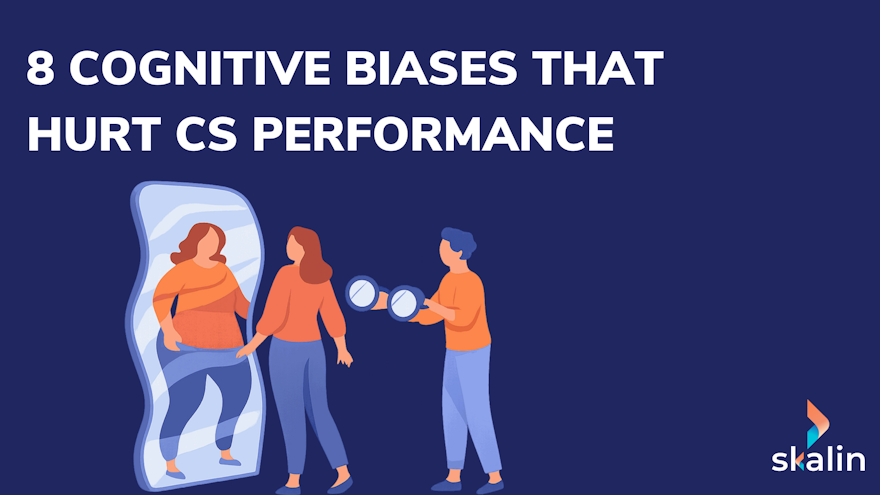
Goodhart's law, the IKEA effect, the prisoner's dilemma and the cobra effect are cognitive biases that unconsciously shape how Customer Success teams prioritise, communicate and act day to day.
In this article, Customer Success consultant Damien Duval shares his advice and best practices for recognising cognitive biases and their concrete implications for how you manage your customers. He offers practical, actionable tips to outsmart them and restore your CS teams' full effectiveness.
1 - The IKEA effect
The IKEA effect is our tendency to overvalue what we build ourselves: projects, software roll-outs and so on. During onboarding, it's therefore important to involve your customer as much as possible in setting up the tool they'll go on to use. That way, they'll take ownership of the decisions made and defend them more readily, especially internally.
But be careful! When a customer invests too much in the project, they may place disproportionate value on their own actions compared with those of the Customer Success team. Give customers too much freedom and they may not be receptive to experts' advice, tending instead to repeat what they've done in the past with other tools. They then risk missing out on best practice and on the value of your software, and will probably end up repeating past mistakes. Conversely, if they're guided too much, they may not fully buy into what's been put in place.
So you need to strike the right balance between autonomy and ownership on the one hand, and best practice shared by the Customer Success team on the other. The key word here is co-creation between the customer and their CSM. By clarifying the goals and each party's scope, a Success Plan or a workspace shared with the customer are effective ways to avoid falling into the IKEA effect trap.
2 - The mere exposure effect
The principle of the mere exposure effect is simple: the human brain automatically comes to like what it encounters regularly, even if it finds it irritating, rather like the summer's big hits that we start to enjoy simply because we keep hearing them.
In customer relationships, the mere exposure effect helps build closeness. Closeness instinctively creates familiarity, which in turn creates a sense of trust.
In Customer Success, this cognitive bias is closely linked to the frequency (and quality) of touchpoints. Companies are generally very present during pre-sale and then onboarding. But touchpoints fade as the relationship goes on.
If you're less present during the run phase, the customer tends to forget about the CS team. To avoid this, you need to keep up exposure throughout the relationship by delivering value at every touchpoint. This applies to both high-touch and low-touch. Only the levers you use will differ.
High-touch vendors will favour regular Business Reviews with their customers, while in low-touch, webinars and newsletters are a way to share best practice, customer stories and product news.
3 - The prisoner's dilemma
The prisoner's dilemma is a central concept in game theory. It describes a situation where two rational players, each trying to maximise their own interest, end up with a worse outcome than if they had cooperated. In other words, individual logic leads to collective failure.
A frequently used example is that of several companies located around a lake, each of which uses the lake's water in its production process. They have to decide how to deal with their waste. The virtuous option is obviously to treat waste properly, which costs more but keeps the lake clean. The second option is to dump waste in the lake, which saves money but pollutes the water for everyone.
The individual reasoning goes like this:
- If a company assumes all the others will dump their waste, there seems little point paying to avoid polluting: the lake will be polluted anyway.
- If it thinks the others will play fair and treat their waste, it may be tempted to cheat to cut costs while still enjoying a clean lake.
In both cases, the selfish strategy seems more profitable for the individual company: dump the waste in the lake.
The collective result: the lake quickly becomes polluted, which damages the environment, public health and, in the long run, the companies' own productivity (unusable water, reputational damage, tighter regulation and so on).
What does this have to do with Customer Success, you ask? We're getting there!
This pattern resembles the love-hate relationship you often see between CS and sales teams. Why? Quite simply because the two teams' interests aren't aligned. Salespeople aim to sign deals, sometimes at the expense of quality. CS then ends up with "bad-fit" customers and early churn. And, more importantly, it hurts the company's performance.
To break free of this cognitive bias, it's essential to align the teams, communicate regularly and set up shared KPIs such as churn or NRR. Commission clawbacks when a customer churns too early are also making a comeback. The aim is to encourage salespeople to sign contracts genuinely aligned with the ICP, and to hold them accountable for doing so.
HubSpot managed to reduce its churn rate by changing the sales team's compensation plan, not Customer Success's. If a customer cancelled within the first 4 months, HubSpot clawed back the commission. That way, salespeople had every reason to close deals with genuinely committed, qualified customers.
4 - Parkinson's law
Parkinson's law states that work expands to fill the time available for its completion. Take support ticket management as an example. If teams have 7 days to clear the backlog, they'll take 7 days to do it, not a day less. Unless there are other incentives.
In other words, the more time you have for a task, the longer you take to complete it. The reverse is also true: when a project is delivered early and the customer has time to react, they're more likely to ask for tweaks or changes.
The answer here is to find the right level of positive pressure to counter this cognitive bias. For example, you can put a little pressure on teams to speed up backlog processing, without being too strict, which would be counter-productive, or too lax, which risks wasting time.
It's a good idea to talk to your teams to agree on realistic goals and set several short deadlines. Setting up a feedback loop to refine goals iteratively is also recommended to improve Customer Success performance.
5 - The cobra effect
The cobra effect is the classic idea that seemed good at the time. Or when the solution proposed to fix a problem ends up making that very problem worse.
The expression comes from an anecdote. A century ago, to reduce the number of cobras in Delhi, the British authorities offered a bounty for every dead snake. Local people then began breeding cobras to collect the reward. When the government scrapped the bounty, the breeders released their snakes, making the original problem even worse.
In a customer relationship context, it can be tempting, for example, to improve customer satisfaction (CSAT) by introducing financial incentives to motivate teams to reply to customers faster. The risk is that this encourages agents to reply hastily, without providing a lasting solution, even if it means bouncing the problem back to the customer. That generates frustration, the opposite of the intended result.
To avoid these counter-productive effects, the right approach is to co-create the strategy with your teams and test it on a small sample to understand how it plays out and what its impact is.
6 - Goodhart's law
This cognitive bias echoes the cobra effect. Goodhart's law states that when a measure becomes a target, it ceases to be a good measure. Take NPS, which is used to measure team performance even though it is, by nature, a customer satisfaction metric.
Turning NPS into a team incentive quickly leads to absurd situations and skews the results. Take e-commerce customer support: there's a 9 in 10 chance the customer service agent will ask you to fill in the satisfaction survey favourably, even if it means tugging at your heartstrings and making you feel guilty.
This dynamic creates pressure to get good scores, which completely undermines the objectivity of the measurement, and therefore the measurement itself.
7 - The Jevons effect
The Jevons effect is a counter-intuitive cognitive bias: the more efficient a system is, the more it gets used. The typical example is car use. With the push against fossil fuels, car manufacturers keep improving their vehicles' fuel efficiency. The upshot: the more economical the car, the more people use it! Even though the aim is to limit the use of combustion engines...
In Customer Success, you can see the same thing with a CSM who picks up on the first ring, or a support team that replies instantly on chat. The customer then assumes it's quicker to call on your CS/support teams than to solve a simple problem themselves (by checking the documentation or the content made available to them, for example).
It's a delicate balance: you want responsive CSMs, but you also want to encourage self-service on simple issues so teams aren't overloaded with low-value tasks. You need the right dose of slight friction on the channels you want to protect: enough to push the customer to look for the answer themselves, but small enough that their satisfaction isn't affected.
8 - Confirmation bias
Confirmation bias is probably the best-known cognitive bias. It's our tendency to favour information that confirms what we already believe. The most common example in Customer Success is ignoring a customer's churn warning signs (falling usage, headcount reductions and so on) because you have a good relationship with them.
Imagine a CSM who has been looking after a strategic customer for several years. Conversations are friendly, meetings go well and the customer seems satisfied. Yet several weak signals appear: usage frequency is dropping, some users no longer log in, and the customer takes longer and longer to respond to the CSM.
Rather than seeing these as early signs of churn risk, the CSM reassures themselves and tells colleagues that "everything's fine, we get on really well, they're just busy."
So they interpret the information in a way that confirms their original belief, that the relationship is solid, and ignore the data that contradicts it. The result: the customer ends up cancelling, even though the clues were there all along.
Conclusion
Our brains aren't always the rational allies we think they are. In the heat of the moment, we all fall into these cognitive traps. Not through lack of skill, but because our minds look for speed.
The examples in this article remind us of one essential thing: we're wired to look for shortcuts.
But this vulnerability isn't inevitable. Spotting a bias is already the first step towards neutralising it. Better still, understanding these mechanisms lets you use them to your advantage to design internal policies built on cooperation, and to put the right KPIs and incentives in place.
In other words, learn to play with your biases... rather than falling victim to them!
Further reading: