
As a CSM, you know the impact you have on your company's growth. Not everyone in your organisation sees it, though, and your leadership team may not grasp the value of CS. That makes it hard to justify buying a new tool or adding a new hire to the team. This is why showcasing the ROI of Customer Success internally is so important.
Which metrics prove the value of CS? How do you secure budget from leadership? How do you demonstrate the ROI of Customer Success? Tom Carnewal, co-founder of The House of Retention and Top 100 Customer Strategist, explains.
Why does Customer Success often seem to be the poor relation in SaaS organisations?
CS sometimes finds it harder to secure budget than other departments, particularly Sales and Product. I think two factors are at play:
- Culture: in the SaaS world, companies are product-focused. That makes sense, as the product is the origin and purpose of the organisation. On top of that, sales is often seen as the only revenue generator.
- Lack of awareness: I recently heard that customer retention is the most underrated revenue lever in the SaaS industry. Many SaaS leaders forget that retention compounds. It isn't just today's revenue, it is tomorrow's revenue and the day after's too.
Generally speaking, growth tends to mask churn. Put simply, as long as the company is growing fast, there is no problem. But when growth slows, churn becomes much more visible. That is when B2B SaaS leaders realise they should have paid far more attention to customer retention.
Are there figures that prove Customer Success's impact on the business?
ChartMogul published a study in 2023 showing that expansion is taking up a growing share compared with new business. The proportion of ARR coming from expansion rose from 28.8% in 2020 to 32.3% today. Over the same period, the proportion of ARR won through new business fell from 62.0% to 57.9%.
A 2023 Gainsight report also puts hard numbers on the ROI of Customer Success. Whether you look at Gross Revenue Retention or Net Revenue Retention, there is a 14% difference in retention rates between companies with a CSM team and those without.

GRR and NRR at companies with and without CSMs. Source: Gainsight
Another study, from ChurnRx, shows a very strong correlation between the ability to upsell an account, notably through the work of Customer Success teams, and low churn. After three years, only 30% of customers who were never upsold are still around, compared with roughly 60% of those who have already expanded.
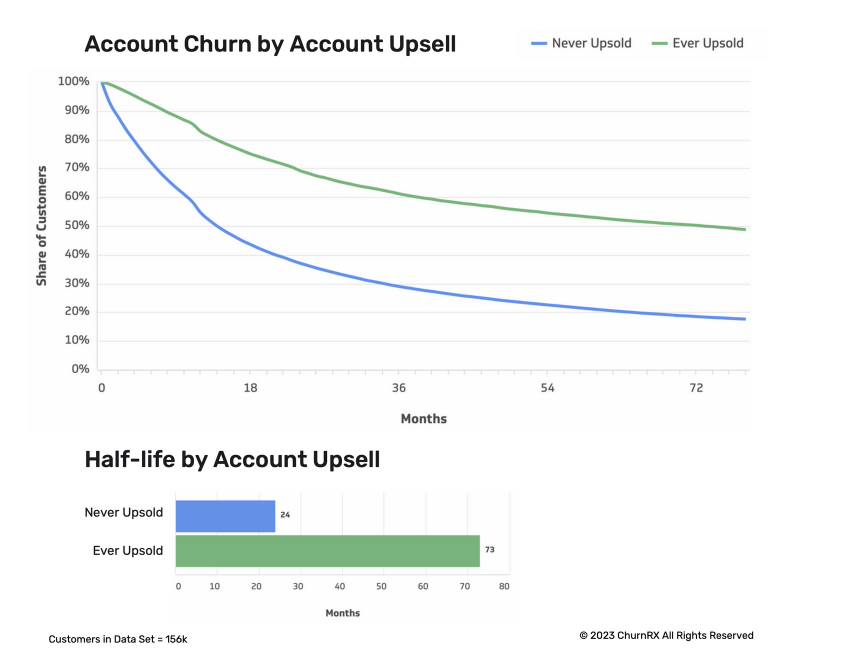
Correlation between upsell and churn. Source: ChurnRx
How can you get CEOs to take Customer Success more seriously?
As this is largely cultural, I think it's important to focus on outcomes. And what is the outcome? Growth in the organisation's recurring revenue. By reminding leaders again and again that customer retention is a major contributor to recurring revenue, you underline why Customer Success matters.
You need numbers to back this up. For example, the gap between 0.5% churn and 4% churn is huge. After five or six years, revenue differs by a factor of four between high churn and very low churn. That shows just how much churn compounds over time.
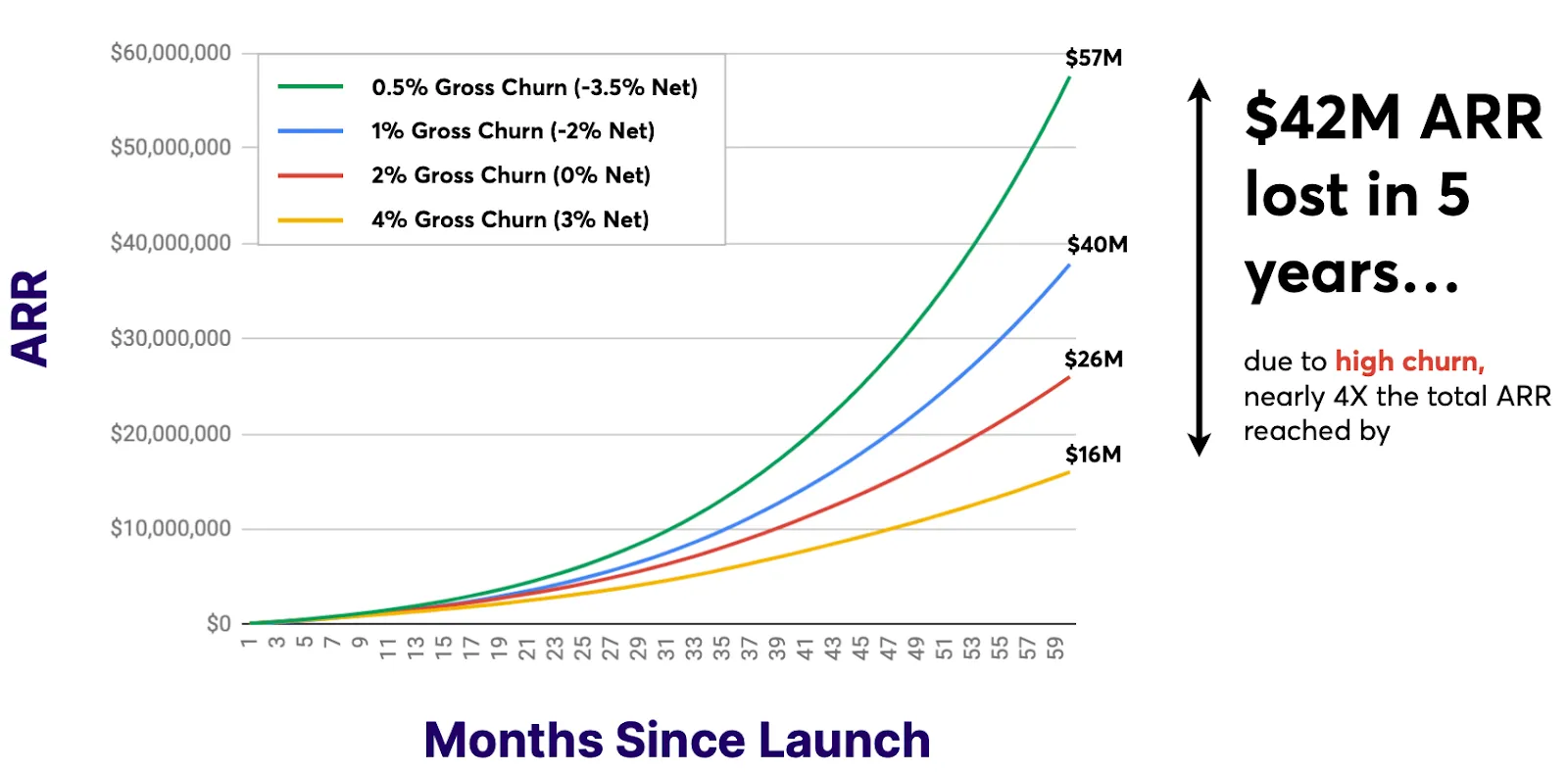
Impact of retention on ARR. Source: Brightback
Which metrics should you track to prove the value of Customer Success internally?
Start with a simple question: why does Customer Success exist? Once again, the answer is retention. The whole point of our work is for customers to be satisfied, stay and keep spending money with us. Second, the purpose of any business is to sell. So ask yourself: what is my contribution to the company's revenue?
There are several good KPIs you can track to show your manager the ROI of Customer Success.
The classics:
- Gross Revenue Retention (GRR): portfolio value at the start of the period / portfolio value at the end of the period (excluding upsell, cross-sell and new business).
- Logo churn: number of customers who churned during the period / number of customers at the start of the period.
- Net Retention Rate (NRR): MRR generated today by customers who were paying a year ago / MRR generated a year ago by the same group of customers.
Some less common ones measure the impact of Customer Success directly:
- Customer Success Qualified Lead (CSQL): whenever your Customer Success team spots an upsell or cross-sell opportunity, keep a record of it. These are CSQLs. Tracing a deal back to a lead passed to your sales or account managers shows the value you generated.
- Customer Retention Cost (CRC): this Customer Success KPI tracks the profitability of the team. You calculate it by dividing the value of retained customers by the cost of the CS team, at the start and at the end of the period.
How do you make the case for a Customer Success budget?
About to ask leadership for budget, tools or a new hire?
Keep three things in mind:
- Speak the CFO's language: CFOs don't think in terms of satisfaction or renewals, they think in euros and profitability. For example, your CFO won't care that onboarding time has been cut by two thirds. Tell them onboarding costs will drop from €2,000 to €700, though, and you are speaking their language.
- Know the leadership team's priorities: if it's growth, focus on growth. Show the leadership team, for instance, how many euros you can contribute through CSQLs. If the priority is profitability, talk about CRC instead.
- Show how you contribute: you can calculate the ROI of Customer Success to justify a budget. For example, show that you can bring costs down by adopting a Customer Success Platform.
How should you present results to justify the budget you were given?
When you present your team's results to the leadership team and justify the budget you received, focus on three things:
- The why: show your team's success, in other words customer retention. Whether you use GRR or logo churn doesn't really matter.
- Revenue: explain how you contributed to the company's top line, for example with the number of CSQLs to back it up.
- Budget: where do you stand against the budget you were given?
Avoid presenting 15 slides at all costs. It hands them far too much ammunition to pick holes in your results, and that is exactly what you want to avoid.
Do you have an example of presenting Customer Success ROI internally?
When we rolled out a new solution, the previous CS director had tried to sell the project on team efficiency. The problem is that efficiency doesn't resonate with a CFO.
So we decided to focus on financial indicators instead:
- Total cost of implementation (Total Cost of Ownership)
- Contribution to retention: running a test in one region where the platform had been rolled out, we found that we had improved retention by 5%. That was worth €56K in barely six months.
- Contribution to new business: we passed almost €30K worth of leads to Sales.
The result: within the first year, we had a 21% ROI from implementing a Customer Success Platform. That is huge, and it is the kind of number a CFO understands.
Further reading:
- Improving retention and upsell in B2B SaaS: tips and best practices
- Customer Success Platform business case: how to win over your CFO
- B2B SaaS: How to Calculate and Analyse Customer Lifetime Value (LTV)
- How many accounts or how much ARR per CSM? Defining the ideal book of business
- How do you run impactful Business Reviews?