Picture this: your salespeople are signing more and more customers, and your new business MRR is shooting up. But at the same time, lots of customers are leaving you or moving to a cheaper plan. The result: your total MRR isn't growing as it should. And every year you lose points of growth.
In this situation, you need to act to reduce churn and get the most out of your existing customers. The problem: there are many possible causes, and many possible levers. To help, Vincent Gouedard, CEO of Fincome, and Nicolas Garmy, CEO of Skalin, share their insights. Read on to find out how to track retention and upsell in SaaS and, above all, how to boost them.
How is the current economic climate affecting retention and upsell?
[Vincent] It won't have escaped anyone: since mid-2022, new business has been getting harder. According to a study by investment fund OpenView, new business growth slowed significantly between 2021 and 2023 for SaaS companies of every size. Especially for companies with $5–20 million ARR and $20–50 million ARR. You need to find additional growth levers.
The other finding: the share of growth coming from upsell is getting bigger and bigger. It accounts for up to 44% for companies with $5–20 million ARR and approaches 40% for companies with $20–50 million ARR. We're in a situation where expansion has become essential. Put simply, growth through upsell and customer retention matters more than ever now that new business has become harder to win.
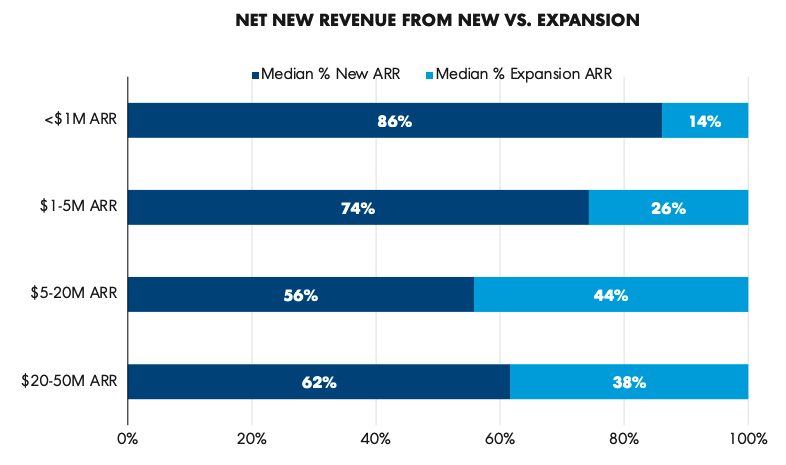
Source: OpenView SaaS Benchmarks Report 2023
Which metrics should you use to track retention and upsell in SaaS?
[Vincent] You can track churn in two ways:
- MRR churn rate: the euros lost to cancellations or downsells, divided by MRR at the start of the period. You can look at this rate at different frequencies and over extended periods. The goal: spot seasonal patterns within the year, which can be revealing.
- Customer churn rate: the number of customers lost during the period divided by the number of customers at the start of the period.
What's interesting is that churn compounds, and that can have a significant impact on ARR over the medium to long term. For example, with growth of 10% a month, the gap between 0.5% and 3% churn could mean $44 million in lost ARR over five years.
Next, I recommend using NRR (Net Revenue Retention). This metric assesses your ability to generate revenue from your existing customer base. To calculate it, you take every change in MRR except those coming from new customers, in other words expansion, churn and contraction. You then divide that by MRR at the start of the period.
If your NRR is above 100%, you're generating growth from your existing customer base. In other words, expansion is more than offsetting churn and contraction.
Why track both NRR and MRR?
[Nicolas] MRR trends show you how the business is developing. They bundle together lots of different realities: expansion, downsell, new business... It's important to track all of that, but it can mask very different situations. NRR is an indicator of financial health.
Net retention is an important metric to track alongside MRR or ARR, which are revenue KPIs. If your NRR is too low, you need to start asking questions about the fundamentals. Even if new business is going really well, if you're constantly filling a bath with the plug out, sooner or later it's going to be a problem.
[Vincent] NRR can even be a good way to set objectives for CS teams. Two things are intrinsically linked to the Customer Success Manager role: churn and the ability to upsell.
How do you identify what's causing churn or a lack of expansion?
[Vincent] I recommend tracking retention and analysing it by cohort, to detect patterns and understand where churn or a lack of expansion is coming from.
Cohorts are groups of customers defined by time period, monthly or annually for example. They let you detect patterns linked to groups of customers who joined on particular dates. There's a given market context and an internal context, such as discounts, communication plans, trade shows and so on.
In particular, you can look at retention rate through cohort analysis. For a given group of customers, you measure this rate over the following periods. For example, for the January cohort, if NRR in month 11 is 89%, that means that for every €100 of MRR that came in in January, €89 remains in month 11. The March cohort has weaker results. Why? A business analysis can help you answer that.
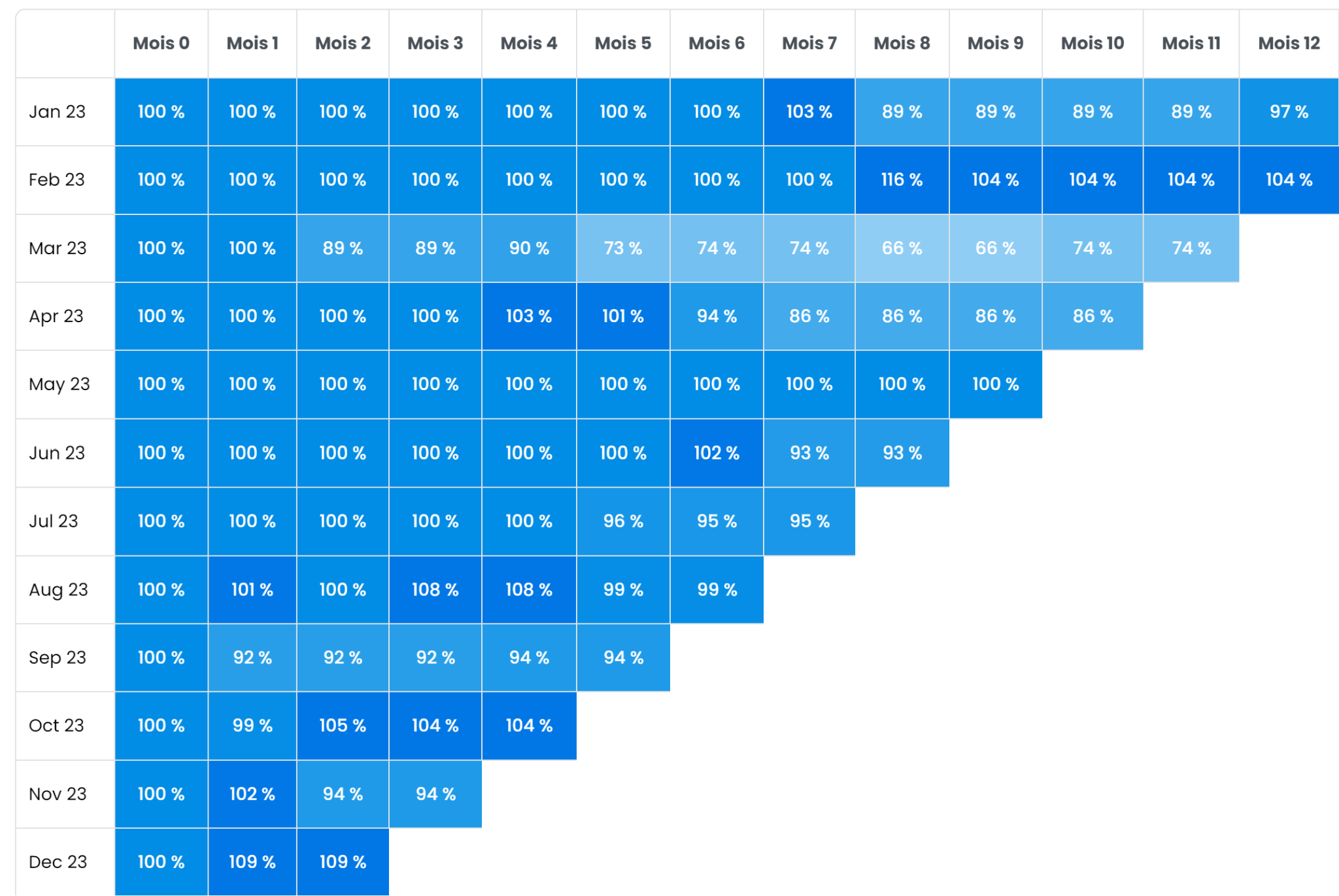
Retention analysis by monthly cohort
What are good churn and NRR rates in SaaS?
[Vincent] According to a study covering 2022, the median customer churn rate in SaaS is 13%. Interestingly, it tends to fall as companies get bigger. This correlation is explained by the fact that larger, more mature companies usually package their pricing better. Their customers' commitments also help them keep churn lower.
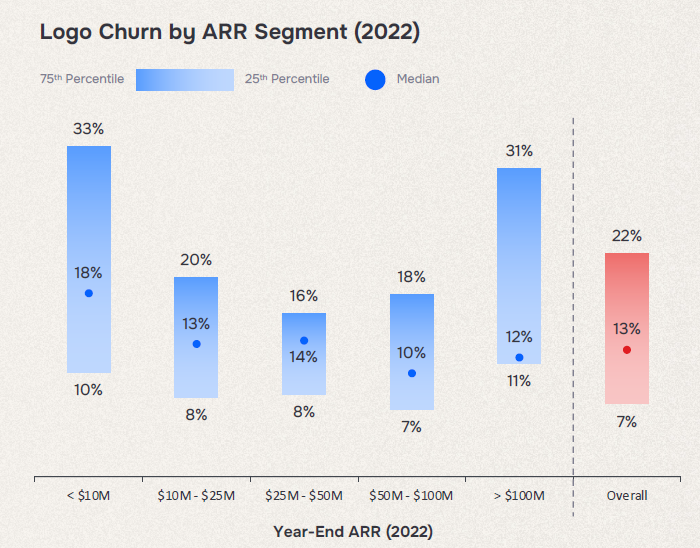
Source: KBCM & Sapphire Ventures - SaaS survey 2023
Another point: there's an inverse correlation between churn rate and average deal size. Servers are a good example: you don't change your hosting provider every day, and doing so has lots of painful implications. As a result, customer stickiness is very high in that kind of business.
As for NRR, median retention tends to rise with company size. In other words, larger, more structured companies are often better at limiting churn and generating upsell.
One final observation: upsell contributes more to ARR growth in large companies. The bigger you get, the harder it is to generate new business. Expansion can account for up to 45% of ARR growth for companies with $50–100 million ARR.
What's your advice for preventing churn?
[Nicolas] First and foremost, you need a good product. You can have the best CSM and support teams in the world, but if your product isn't up to scratch, you won't get good churn rates.
Next, a good customer-product fit is essential. Ask yourself: "Am I selling my product to the right customers?" Look at which customers things are going well with today. The idea is to redraw your customer profile to check that your real ICP (Ideal Customer Profile) still matches the theoretical ICP defined by Marketing or Sales. The lines can shift over time.
Onboarding quality is also a key driver of your customers' future loyalty. I need to onboard my customers quickly and help them see the value the product will bring them early on. As proof: a ChurnRX study shows that customers without minimal use of the solution in the first 10 days had a cancellation rate 10 times higher during their first year.
Remember to centralise your customer data. Today, most CSMs have a CRM holding lots of information. Perhaps you log your meeting notes there. Alongside that, you have a back end with customer login data, and perhaps a ticketing or project management tool. In most cases, these tools are managed in silos.
That creates three problems:
- No 360° customer view: if I'm in a CS team, to check my customers are doing well I have to go into both the CRM and the back office at regular intervals. It's very time-consuming.
- A lack of proactivity: this wasted time means CSMs are always a step behind what's happening in their portfolios. As a result, they're more reactive than proactive.
- Missed opportunities and churn: you can miss out on upsells and, in the worst case, receive a recorded-delivery letter from a customer cancelling their subscription.
The solution is to centralise customer data. Put simply, make sure your tools talk to each other properly so all the information is in one place. You can do this by building your own data warehouse or in a CS Platform such as Skalin.
How can you predict cancellations and prevent churn?
[Nicolas] There's a widespread belief in SaaS: "Net Promoter Score (NPS) tells me whether my customers are satisfied and predicts whether they'll churn." Yes, it tells you whether customers are satisfied, but it doesn't predict whether they'll cancel. Studies show that in reality there's no correlation between NPS and churn.
To find out whether your customers are at risk of churning, you need to set up a proper health score that combines your customer interaction data with platform usage and changes in contract value. It draws on lots of indicators to give you a true picture of your customer.
What strategies can you use to encourage upsell?
[Nicolas] To create upsell opportunities in SaaS:
- Avoid monolithic products where everyone has access to every feature.
- It's worth having products split into modules. These can form the basis of your plans, and each plan becomes an opportunity.
- It's useful to add premium features: things that aren't included in the plans but that customers can switch on as an option.
Next, avoid per-user pricing in times of crisis. If there are redundancies, fewer people will be able to use the solution. Instead, you can:
- Charge by usage: in practice, a package includes a set number of invitations, say. If you want more, you need to upgrade. Livestorm, for example, works on this model.
- Limit features by plan: the feature is the same, but the higher the plan, the more steps or options I get. In other words, the feature is capped on smaller plans. This can be a great way to let users get a feel for the feature while frustrating them just enough to make them want to move up a plan.
- Isolate features: at HubSpot, for example, the workflow feature lets you automate tasks and processes, and the sequences feature lets you send emails. Depending on your plan, you may have access to both features, but you can't have a workflow trigger a sequence. For that, you need to move up a plan.
- Raise your prices: you need to do this regularly. I recommend adding an indexation clause to your terms and conditions to link your prices to an annual index. That way, your price legally rises in line with the index from one year to the next.
[Vincent] There's another very important factor we see with our customers: communication. You can justify price increases by highlighting product developments, new features or other factors specific to your market. Planning that communication in advance and anticipating the dates when prices will change are good practice.
How should you organise your teams to improve retention and upsell?
[Nicolas] Supporting internal change is important. The person ultimately accountable for churn is the CEO, not the CS team, even if it bears its share of responsibility.
The CEO sets the direction and needs to align teams around shared goals using the right KPIs. Let me give an example we see a lot: the marketing team has to deliver a volume of leads, SDRs a volume of meetings... But are they the right leads? The right meetings? After that point, it's no longer Marketing's or the SDRs' problem, and so Sales ends up signing customers who aren't necessarily a good fit.
Ways to improve this include:
- Factoring good fit into sales incentives: put simply, salespeople are rewarded if they sign the right customers, the ones you retain.
- Limiting the extras offered at signature. If, as a salesperson, I give away too much, I cut the ground from under the people who come after me, the CSMs and AMs. Limiting this kind of discount leaves room for upsell later on.
I also think you need to train CSMs in sales. The aim is for them to feel comfortable and to learn to ask the right questions to spark the customer's interest in upgrading. There's a phrase I like: a CSM's job isn't to sell, it's to make customers want to buy.
Finally, I recommend breaking down silos between teams. Why? CS teams often report to a different leader from Sales, so there's a risk of pulling in different directions. One way to align teams is to bring them under a shared leader, for example by appointing a CRO (Chief Revenue Officer) responsible for all revenue functions.
Further reading: