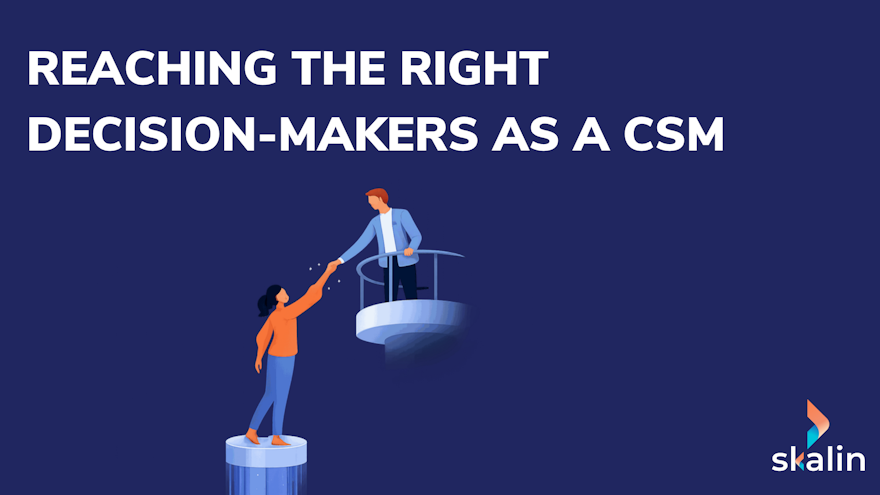
Between operational teams and sponsors, Customer Success teams have to deal with contacts at several levels. But access to the decision-maker is essential to keep your customer's teams aligned with your product. What are the keys to reaching decision-makers? What kind of conversations should you have with them? Elliot Ghnassia, Chief Customer Officer at Sociabble, shares his experience.
When we were preparing this interview, we quickly agreed on this topic. Why do you think it's such a major issue?
My experience has shown me that most Customer Success performance issues revolve around this one problem: having the right level of contact. For example, I've noticed it's often a recurring cause of churn, resulting from a lack of alignment and visibility between the product's value and the company's key objectives.
It's also a complex issue to manage, so even though everyone agrees it's important, it's a tough nut to crack. Teams, especially more junior ones, often don't fully understand it. Only experience really shows you why it's critical, and which keys open the door to these contacts.
Before we get into the heart of the matter, can you describe the different types of contacts your CS team deals with at Sociabble?
In short, as we have a fairly high-touch model, we deal with 3 types of contact:
- First, there are the operational teams, the people who deliver on the ground, configure and use the tool, and so on.
- Then there's sponsorship, with the sponsor or sponsors who decide the strategic direction of the project.
- And finally, the project manager. This is the person responsible for the project's success, who reports to the sponsor and manages the operational team.
Of course, this is all fairly schematic and can vary depending on the organisation and the size of the project.
At Sociabble, who is responsible for talking to whom?
It depends on the size of the project.
For small and medium-sized projects, the CSM works with both the operational teams and the sponsor. This has some advantages: the CSM knows exactly what the project team is putting in place on the ground, which allows for detailed conversations with the sponsor. The big drawback, though, is positioning: the sponsor will naturally see the CSM as being at the same level as their operational teams rather than at their own level, which limits closeness and makes access harder for the CSM. So we play other cards in the company, mine for example, to set up these meetings.
For the biggest projects, we work as a team, led by a Customer Success Director (CSD) with one or more Digital Project Managers (DPMs). In this set-up, the mirror with the customer's team is clearer. The CSD works with the sponsor and the DPMs with the operational teams. On the largest projects, we may have contacts very high up the hierarchy, up to the managing director or CEO. In those cases, we add another level, which can be either me or our CEO.
CSMs mostly talk to operational staff. Does it come naturally to CSMs to talk to decision-makers? Did it come naturally to you at first?
No, it doesn't come naturally, you're absolutely right. And that was the case for me at first.
I learnt mainly through experience. Of course, I had managers who coached me early on to put me on the right track. Then the years of experience added up. I think anyone who has spent enough time on large customer-facing projects can testify to the impact of a conversation with the right people, or, conversely, to the disasters that a relationship stuck at too operational a level can cause. Unfortunately, I can think of dozens of examples.
As Oscar Wilde said, 'Experience is simply the name we give our mistakes.'
The goal, though, is to speed up that realisation and that skills development. If we had to wait for everyone to stumble enough times to learn on their own, it could hurt the company...
I've noticed 2 situations that hold back conversations with sponsors, and each calls for a different way of supporting the team.
- First situation: 'I don't feel qualified to talk to this person, I'm not at the right level for that conversation'. The famous impostor syndrome. In this case, I get them to organise the meeting and spend time with them preparing it. It often reassures them about the topics to cover and helps them feel calmer during the meeting. I also often join these meetings so they can learn the right kind of messaging, by taking over from time to time during the conversation, which shows them how to approach certain topics.
- Second situation: 'If I talk to my everyday contact's boss, it's not fair on the operational person I know so well'. This one isn't easy to counter, because it isn't necessarily wrong. It all depends on how you make contact. So I try to guide them on how to do it tactfully. For example, if you don't know the sponsor and your operational contact has openly said 'don't contact them, they don't have time for a meeting', the approach can instead be an individual email along the lines of 'Hello [sponsor], just a quick email to introduce myself and what I do. I'm available if you need anything, and I'd be happy to discuss such and such topics at some point.' It's a fairly neutral approach that plants a seed you can come back to later. After all, it's quite normal to introduce yourself to the person funding the project, and if they're interested in talking, they'll say so.
Both situations are completely natural, but ultimately they're misguided. In my view, they're a kind of perception bias that you need to overcome.
Several levels of contact also means several levels of communication. Can you explain what they are for you?
I'd say there are two types of conversation. Within each, there can be further levels depending on the size of the project and how high up the company you go.
- There's a first, 'strategic' level, where contacts (sponsors) are mainly concerned with making sure the project as a whole is heading in the right direction. A first conversation of this kind might involve identifying or confirming the company's business challenges, then working to link them to a strategic vision for the project with concrete, quantified objectives.
- Then there's the second, 'operational' level. Here, contacts are more concerned with solving concrete delivery problems in order to reach the strategic objectives. Conversations will focus on what needs to be put in place to achieve those objectives, for example questions about how to use the tool's features.
In fairly large organisations, the levels can stack up, and in my view the idea is simply to adapt to your contact's concerns and perspective.
For example, you'll have strategic conversations with a communications director just as much as with the company's CEO. But they won't see certain topics in the same way. The CEO will have a more macro view of the company's challenges in the broadest sense, across departments and deeply connected to the business. The communications director will see those challenges with more nuance on the communications side, and within that scope will have a deeper view of the functions directly around them.
The same goes for the operational side: in large organisations, you can split this type of conversation in two. First, organise delivery with the different teams or contacts, then tackle the various concrete topics with the people concerned.
In your view, should you involve decision-makers in existing meetings, or create dedicated ones?
You need both, but as you say, not for anything and everything.
First, creating dedicated meetings is essential. Decision-makers are often high up the hierarchy and in high demand. So they'll carefully allocate the time they spend on each topic they're involved in. For them to block out time, the topic has to be worth it, so you need to organise a dedicated meeting with a very precise agenda that makes clear why it's worth the sponsor's while to attend. For example: you need their approval on certain critical issues, their view on the root cause of certain difficulties, their perspective to make sure you're moving in the right direction, and so on.
Second, it's crucial to reach out to them between these meetings when topics need their attention. It helps build the relationship. If, for example, you notice that decisions taken on the project could prove disastrous, but you can't convince your contact, it's important to escalate the warning: 'Hello [sponsor], I'd like to flag a concern about this specific issue. Our experience shows it could put the project at risk. Could we take 10 minutes so I can share the details with you and you can make an informed decision?' Without blaming anyone, of course. The idea is always to give the customer the information so they can decide. At worst, the sponsor says no too, but at least you've done your job and nobody can accuse you of not having warned them. In fact, it's often best to put it in writing.
On the customer side, operational teams often say there's no need to involve the decision-maker, that they trust them and are short of time. How do you get what you need without contradicting them?
That does happen very often, and as you say, the key is not to 'contradict' them, which is almost the most important thing. Contradicting them head-on would amount to saying the decision-maker doesn't trust them, which is neither flattering for them to hear nor necessarily true (and whether it's true or not isn't a discussion you want to get into anyway).
What this reaction really shows is that your contact doesn't see what's in it for them in having you at that meeting. They're not going to ask the sponsor for time just to please you. They're probably also worried that the conversation will be used to pitch and 'sell to their boss'. Put like that, you can only agree with them... So you need to show this person why it's worth organising the meeting and putting you in touch with the decision-maker.
To answer them, first of all, I don't make it about 'me' wanting to meet the decision-maker, or why 'I' think the meeting is worthwhile.
I explain why our other customers value these meetings: they want an outside analysis to show impartial results (which also implies that we do the groundwork for their reporting to their manager); they're also pleased when an external company highlights the work done by the project team (it's always nicer when others say it than to praise yourself); and they find it more effective when an external company highlights the areas for improvement that often need the decision-maker's approval (making clear, of course, that all these points are agreed together before the meeting).
Then I explain what we at Sociabble get out of it. Presenting this analysis to the sponsor gives us feedback from someone directly concerned but further removed from the project. That feedback is very valuable in helping us better understand the company's context and challenges, and so help our contact achieve results more effectively.
How do you bring value to people who often have many more pressing concerns than your tool?
That's an excellent question, and one that comes up a lot. My answer is fairly simple: the subject isn't the tool, it's what the tool is for. Your tool has to address key challenges for this person, otherwise it means you sold your product on a misunderstanding... or on a lucky break that may not last. So don't talk to them about your tool; talk about their business and operational concerns.
How often do you try to meet decision-makers? At what points do you try to involve them?
It ranges from quarterly to annually, depending on the size of the project and how involved the decision-makers are.
I don't think there's one rule for everyone. I'm not a fan of QBRs (Quarterly Business Reviews), for example, because of the 'quarterly'. In my view, you need to agree with the sponsor on the most suitable cadence.
To do that, we try to meet them as early as possible in our process. For example, at the end of the pre-launch phase, we invite them to a go-live sign-off meeting. That's when we decide together how often the strategic reviews involving the sponsor will take place during the run phase.
All of this is fairly formal. Are there other ways to build the relationship?
Yes, there are several ways to stay connected, which I try to apply myself, though not without difficulty, to be honest.
First, being present on social media, especially LinkedIn, is extremely important. You need to be connected on LinkedIn with 100% of your customer contacts, especially sponsors, follow what they post, and react and comment.
Next, organising exchanges between companies also works very well to position yourself as a strong source of support. Try to put them in touch with people in the same role at other companies, to help them share experiences.
Finally, help them showcase their work through articles or interviews about what they're doing well. It's often good for the sponsor's visibility, but also for you, since it gives you valuable content with an interesting customer story. This last point is more limited, as it only works for companies that are performing well with your solution.
Sometimes sponsors leave, and then a whole relationship has to be rebuilt. How do you get it going again?
First, and although it's not quite the question, it's still vital: it's very important to stay connected with the people who leave. They could become customers again at their next company. Again, LinkedIn!
Then, yes, to get the relationship going again, you first need to know who's taking over. And reconnect very early, making it clear that you want to understand the new person's strategic vision for this existing project. That's the most important thing. A new person joining the company, especially at sponsor level, will want to make their mark, either through a new project or by bringing a new approach to an existing one. So they need to feel comfortable with the project and see clearly that it can give them visibility: for example, by improving on past results.
Further reading: