

Passing on feedback is one of a Customer Success Manager's many responsibilities, and rightly so. But what happens to that information afterwards often leaves a lot to be desired, and the lack of visibility can cause friction between teams. Here are a few tips to improve your processes and use feedback to reduce churn.
"I've passed your feedback on to my Product team, but I haven't heard back yet. I'll chase it!" Almost every Customer Success Manager has said this at some point. It's understandable: collecting and handling customer feedback isn't easy.
Which channels should you use to collect feedback? How do you handle it effectively to avoid the black box? What are the business implications? Valentin Huang of Harvestr and Nicolas Garmy of Skalin share their advice on retaining customers through customer feedback.
What is customer feedback for in a SaaS company?
[Valentin] Feedback is the link between Product and Customer Success. These two teams work together every day on customer feedback to improve the product and help users get the most out of it. It's a tool for achieving shared business goals, namely reducing churn and increasing revenue.
For Product and Product Management, feedback is used to:
- Identify new problems to work on: these are new needs that can be met with new features.
- Prioritise: make decisions about the backlog, whether for continuous improvements or, at a higher level, for building a roadmap. For example, you look at which topics come up most often in feedback to inform your decisions.
- Build the right features: once Product has identified the needs it will work on, the customer verbatims that come through feedback help you understand the need. From there, you can find the right solution or feature to address it.
- Validate a feature's impact: in other words, check whether it really met the need, and close the loop. You identify new problems and improve the feature if necessary.
[Nicolas] For Customer Success, it's also very valuable.
- Identify recurring pain points customers may have, and influence the product roadmap.
- Prioritise accounts and spot at-risk accounts. You target those showing signs of concern and take action.
- Encourage adoption of certain features. Imagine you receive feedback asking for a specific feature. Perhaps it doesn't exist as such, but you can achieve the same goal by repurposing something already in the product.
- Identify upsell opportunities. Either the CSM handles it, or passes it on to Sales.
- Reduce churn. If it's well managed, there's more buy-in and satisfaction because customers feel listened to, and that helps increase revenue.
Where does the "black box" perception come from?
[Valentin] At Harvestr, we analysed figures on how our customers manage feedback. They're B2B SaaS companies, from start-ups to businesses with 1,500 employees.
- On average, there are around 130 pieces of feedback a month, coming through 4 channels, the most common being CS, Sales and Support. We've noticed that the bigger the company, the more channels there are. And more channels means you need to centralise to get an overall view of needs.
- Only 10% of feedback over a year is turned into features, since some feedback isn't relevant, either at a given moment or at all. That's a low figure. As a result, you need to be able to filter and prioritise quickly to make the right decisions, especially if you get a lot of feedback.
- The last interesting figure is that there are on average 306 days between the feedback idea and the feature going live. The reason: there may be large-scale product innovation projects that take time. And there are always lots of topics to prioritise, so between user research and prioritising a piece of feedback, almost a year can go by. That's a long time.
This means there's a communication challenge between Product and Customer Success. CSMs need to know that a feature request can take a long time to be prioritised. You mustn't leave CS teams, let alone the customer, in the dark.
How can Product teams communicate better about how feedback is handled?
[Valentin] CSMs play an essential role in this process. We saw this in a study we ran last year on product discovery practices (the user research phase). Customer Success is the third most involved department, after Product and Design. The reason is simple: as a CSM, you talk to customers every day and work in depth on their needs, which is less true of other departments.
So you need to understand what good feedback looks like. It's also essential for collaboration between CS, Design and Product to be as smooth as possible.
The biggest challenges in managing feedback are:
- Poor qualification: Product teams often say that feedback coming from CS isn't qualified. The customer wants something, but it can be hard to use that to build a feature. Sometimes there's a "shopping list" effect that makes the feedback impossible to act on directly.
- Prioritisation: a piece of feedback on its own doesn't say much. You need to ask: who's the customer? How much do they matter to us? What's their churn risk? Have they already churned? This information is essential to qualify the feedback and help prioritise.
- Communication: once requests have been prioritised, how does the Product team provide transparency on the roadmap? For CSMs, that's essential information to pass on to the customer.
- Closing the internal feedback loop: once the feature goes live, CS needs visibility on the feedback. And the customer needs to know that the company really is listening to their needs and that the feature they were waiting for has shipped.
[Nicolas] Looking at it from the Customer Success side, there's clearly a misunderstanding. We don't always feel we know what Product expects. For example, I've worked at companies where we were told: "To submit feedback, you need to estimate the impact, how much MRR it will generate..." That's impossible to manage in CS! Processes need to be harmonised so everyone understands what good feedback is.
To be fair, CSMs struggle to prioritise feedback. That's because we empathise with the customer and feel everything is urgent. It's hard to know where to put the effort!
Sometimes it also feels like throwing messages in a bottle out to sea. I've created a card, but I don't know when it will be done, or whether it will be done at all... And as a result, I can't give my customer any visibility. Product and CS have different perspectives, and they need to align their processes to get out of this black-box situation.
[Valentin] That's because a good feedback management process hasn't been put in place. The black-box effect, especially on the CS side, will grow as the company grows. The risk is that once you have no visibility on what happens to feedback, you stop passing it on. That's understandable: the process takes time for nothing.
The consequence for Product: you lose extremely valuable information for improving the product, reducing churn and increasing customer satisfaction. You must avoid this black-box effect at all costs.
How do you collect relevant feedback to reduce churn and drive upsell?
[Valentin] The ultimate goal isn't just customer satisfaction, but also business impact. In other words, how do you improve retention and upsell?
You need to capture as much relevant feedback as possible throughout the customer lifecycle. For example, during quarterly account reviews, through support tickets or via Net Promoter Score (NPS).
Note that CSMs sometimes don't dare ask customers awkward questions, which is why it's worth structuring feedback collection around dedicated forms at different points in the customer's life. Some customers feel freer using a form, while others prefer to go through their CSM. It's worth having several levers to encourage feedback.
After churn, you can also set up collection channels:
- A form in the subscription cancellation process
- Surveys of customers who have already churned, although it's quite hard to get feedback at that point. Incentives can, however, encourage responses.
The more of these channels you identify, the more material Product will have to stop the next customers from churning.
Then there are all the other sources. For example, feedback from Sales and user interviews. It's important to map these channels and bring them together in one place, with customer verbatims.
[Nicolas] The goal is to automate collection. One way to do that is to use workflows in your CRM, or playbooks in a Customer Success Platform.
It can be useful to ask the customer for feedback at different points in the lifecycle. For example, at the end of onboarding, or when the customer moves from one stage to another, notably through NPS surveys. Response rates can be low, around 15%, but it's still good practice to do this automatically, at specific moments.
Another way is to ask based on behaviour. For example, you want to collect feedback on a feature you've just launched, at the moment the customer uses it for the first time or reaches a certain usage threshold. The aim is to automate all of this with a tool.
[Valentin] At Harvestr, for example, we go looking for feedback before churn happens. It's far more effective than collecting feedback after the person has already churned. We automatically send an email via Intercom to users when we see their usage dropping.
We explain why we're getting in touch and keep the message as simple as possible. That gets us good response rates, around 60% or even more. You can do this as long as you have the right usage data and a tool. You end up with a steady flow of feedback in your inbox.
Alternatively, you can do what Weglot does. They collect feedback when churn happens. In practice, when I go to cancel my subscription, I'm asked whether I have any feedback to share on improving the product. What's interesting is that I have to enter this feedback before I can click "confirm". It works well if your tool is very self-service.
How can CSMs manage the feedback they receive?
[Valentin] What matters for CS and Product is to structure the feedback that's passed on. The idea is to avoid it being too brief, along the lines of "The customer wants this, full stop."
A template with 3 simple things keeps it painless for the CSM and makes the result usable for the Product team:
- What is the customer asking for?
- What problem is the customer trying to solve?
- How high a priority is this feedback? For example: churn risk, must-have or nice-to-have
You can add other details, such as the customer's context and MRR.
The idea of the template is to capture the customer's language, but also to translate it into Product language. For CS, that means making the effort; for the customer too. When the customer asks for a feature, the reflex should be to ask "Why do you want that?" You may realise there's already a way to do it in the product, which saves you passing on the feedback. And if not, it's very high-quality information for Product.
[Nicolas] All too often, the feedback is "We need the red button", when the best answer to their problem isn't to create a red button. Nine times out of ten, you get a feature request rather than a problem to solve, yet describing the problem is very important.
How can Product make the most of this feedback?
[Valentin] You need information about the customer to prioritise and know where the churn risks lie. For example: the customer's health score, NPS, ARR...
If you can do that, you have the information you need to prioritise initiatives that will have a business impact. That's very valuable for Product, because it helps you make the right decisions and have a real impact on churn.
For example, you can look at which features were most requested in a given quarter. Or: which opportunities have the most revenue at risk? If 10 customers are asking for this feature and they represent 50% of revenue, I'll be inclined to take a look.
To prioritise, Product can also identify the missing feature that has caused the most churn. The aim is to stop similar customers churning in future.
[Nicolas] At Skalin, on our own roadmap, we try to identify quick wins. These are customer requests that are very easy to fix, need little development, but create a lot of satisfaction. You need to be able to slip them in outside the roadmap, as you go.
How do you feed and sustain the feedback loop?
[Valentin] There are 4 key stages in feedback management:
- Creating the feedback
- Processing by Product
- Prioritisation
- Feature roll-out
It's very important for the Product team to give the Customer Success team visibility on at least these stages, to avoid the black-box effect.
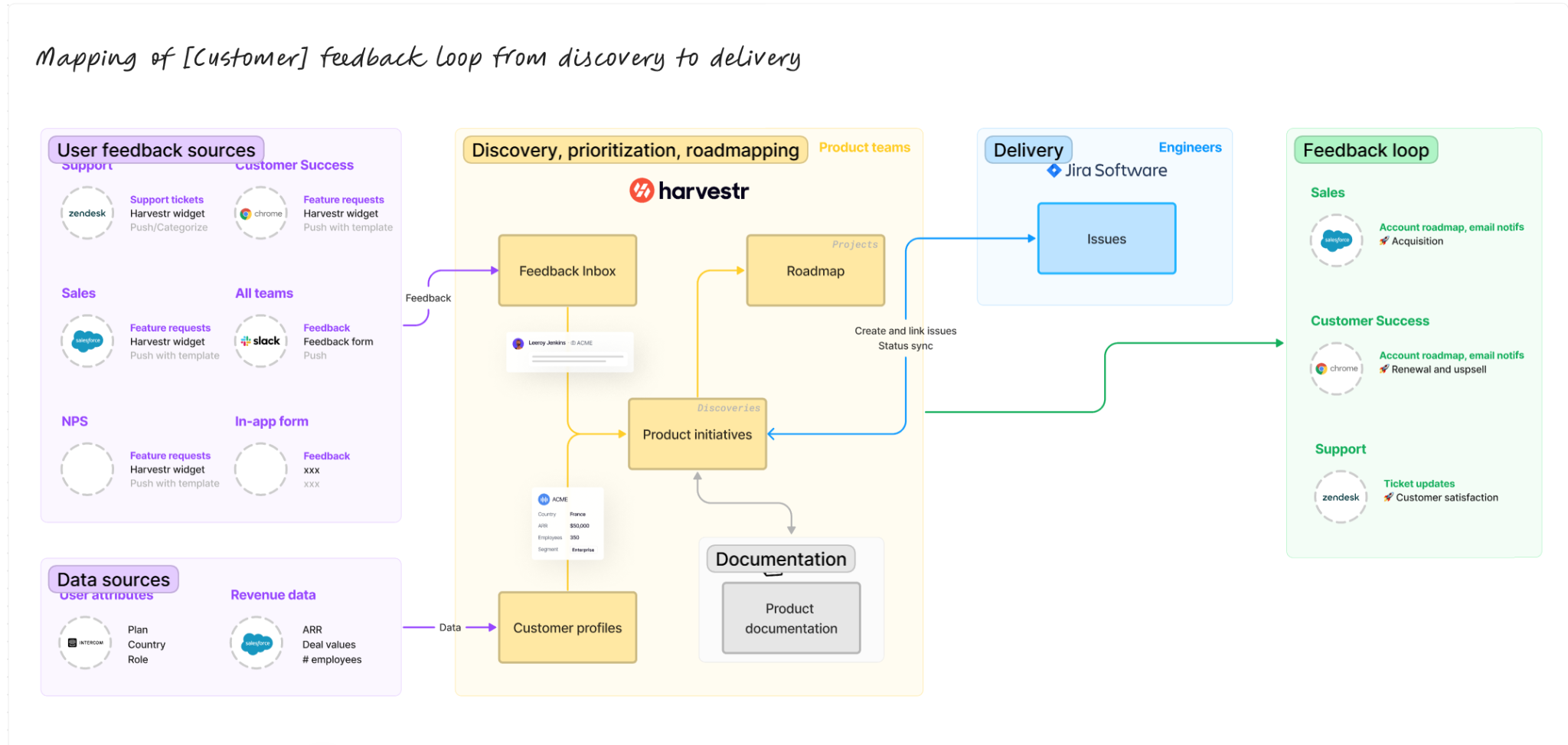
At Harvestr, we have a feedback loop in Slack. The feedback loop provides visibility as soon as Product has prioritised a request or its status changes. Product and CS need to agree on what information can be shared. Saying "No, we won't do it" is better than saying nothing or putting the problem off.
Once the feedback is prioritised, you can give more detailed visibility. It's hard to give precise dates, and it's risky, because it can create expectations that aren't met. One option is to give a rough timeframe, such as the quarter in which the request will be handled.
Then you need to close the loop, both internally and with the customer. At the end of the loop, the CSM should be notified when the feedback becomes a feature, so they can let the customer know.
Another useful tool for CSMs is a view of their accounts linked to the feedback they've submitted and where it stands on the roadmap. That way, when you meet a customer, you know you've dealt with this or that piece of feedback. It's very useful, especially at renewal time. It helps show that you're really listening.
At Harvestr, we use a tool to map the overall feedback loop. Building and visualising this process is a very useful first step. It's the moment when CS and Product can agree on which channels and templates to use.
What do you think of public roadmaps?
[Nicolas] That's what we do at Skalin. There's 3 to 6 months of visibility and we don't commit beyond that. Personally, I'm very much in favour. Bear in mind that you need two roadmaps. In other words, within your internal roadmap, identify public cards that everyone can see.
We chose not to make it 100% public for competitive reasons. We call it semi-public. To see it, you need access to Skalin, and you view the roadmap from within the platform. It lets us get back to customers who made requests once we've released the solution to their problem.
A caveat, though: it means honouring a certain level of commitment. Once in a while, something may slip from one quarter to the next, but if it happens every time, you'll lose everyone's trust.
[Valentin] There are certainly industries where it makes sense, such as open source. There are lots of public roadmaps there, sometimes directly on GitHub. You need to be transparent.
I don't have hard evidence on the impact of a public roadmap on the business or on understanding customer needs. I see it more as a communication tool that provides visibility and can help manage certain requests better.
[Nicolas] For us, it also helps build a user community where people can share feedback and find what's being said in one place. It makes them feel listened to. That's the aim of anyone who publishes a public roadmap.
Which tools should you use to improve feedback collection and prioritisation?
[Valentin] Harvestr lets you do everything we've discussed, such as centralising feedback and linking it to customer data. There are of course other ways if you're prepared to put technical resources in-house. Either way, what matters is to start by mapping your feedback loop, then look at where the feedback is, where you want to take it and how to do so as simply as possible.
How does the feedback loop help reduce churn?
[Valentin] You can have a business impact if you've made the right decisions upstream. That means using the right data, knowing where the churn risks are, and so on.
But on the CS side, the moment you can use feedback to prevent churn is when the loop closes. If you know a feature has shipped and that a particular customer asked for it, CSMs can go to the accounts in question to tell them about the new feature, check it meets their need, and secure the renewal before it's too late.
The feedback loop is also essential for turning feedback into a business opportunity. If you can link a piece of feedback to an upsell opportunity with a given customer, you can go back to them with the good news.
Further reading:
- CSM and Product collaboration: from the front line to the roadmap!
- Improving retention and upsell in B2B SaaS: tips and best practices
- CSAT, CES, NPS: which satisfaction metric should you choose?
- The 8 real reasons for churn in B2B SaaS (and the action plan for each)
- Customer offboarding: how to handle a customer's departure well in SaaS