Your SaaS customer base is growing fast. As a result, your Customer Success Managers need to prioritise and know which accounts deserve their attention. That's where the health score comes in. But there are different ways to calculate it. Business rules or artificial intelligence: here are the pros and cons of each approach!
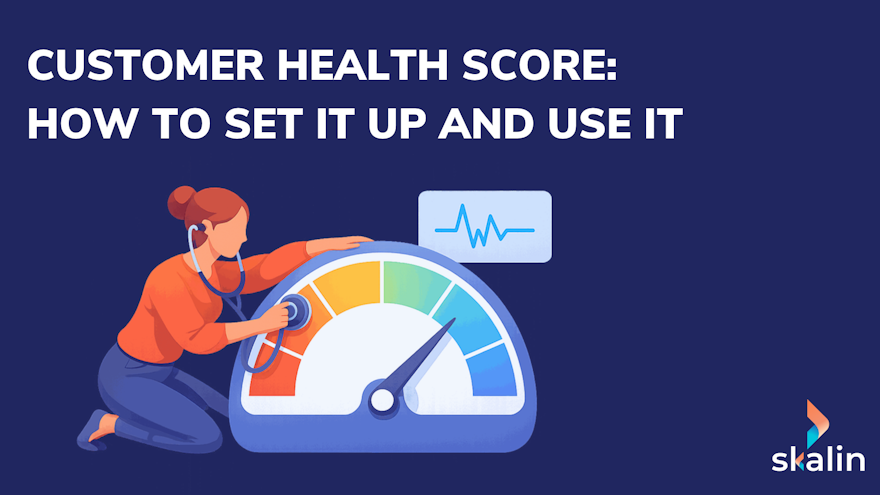
The health score (or Customer Health Score) reflects how healthy a customer is and how likely they are to stay loyal. The lower it is, the higher the risk of churn. That makes it a vital indicator for any business built on recurring revenue, SaaS in particular.
You still need to be able to trust it, though. And that's often where things get complicated: which approach should you take, which factors should you include, which obstacles should you avoid?
Two approaches: deterministic vs algorithmic
There are two main ways to design a health score:
- The deterministic approach is the original method, and still the most widespread. You define the rules and conditions that make customers gain or lose points yourself. In practice, it looks like this: "if at least N users use feature X within Y days of step A, AND [another condition], THEN...". The upside: you control the rules and understand the score completely. The risk is building your entire model on assumptions that turn out to be wrong, and missing the mark completely.
- The algorithmic approach tackles the problem from the other end. An algorithm identifies the relevant indicators by analysing a large number of signals. The goal: automatically detect the customers who need your help to avoid churn, and those who are doing well and have upsell potential. This approach lets you analyse far larger volumes of data, with no preconceptions.
The 4 pitfalls of a health score based on business rules
The same difficulties come up almost every time you build a score from rules you define yourself.
#1. Not enough perspective on what actually predicts churn
Picture it: you have to set rules without knowing which data really makes the difference! You probably have your business instincts, but rarely the evidence to back them up. Even if your company has a data team, chances are it's focused on other priorities serving the product roadmap, not on analysing the behaviour that preceded your churned accounts. And as W. Edwards Deming put it: "Without data, you're just another person with an opinion."
#2. Scattered data
Another common obstacle: the data exists, but it's spread across your CRM, your ticketing tool, your back office and your inbox. In other words, your customer information is siloed, which stops you using it effectively to build a robust health score.
#3. A static score that's expensive to maintain
By definition, a deterministic score is static. It doesn't account for seasonality. Take retail: before and during the sales, your customers are very active and show excellent scores. Straight afterwards, they use your solution less and their scores plummet, even though the relationship hasn't really changed.
And seasonality is just one example. Your product grows richer, your commercial offer evolves, and so does your customer mix. Every change has to be reflected in the score manually, or your model quickly becomes obsolete. So you need to set aside resources to maintain it.
#4. Blind spots... and several iterations before it's reliable
Each rule relies on a narrow set of data, since you're the one choosing the criteria. Your score is therefore built on a handful of metrics you consider important and leaves the rest aside. You can miss an essential criterion for months.
Until the day a customer everyone thought was healthy cancels. You analyse their behaviour and do find an anomaly... one your score didn't account for. You add the condition. A few weeks later, another customer leaves for a different reason. Back to square one. Put simply, the model only becomes reliable after several churns.
So the real question is: how many customers will you have lost in the meantime?
Health scores and artificial intelligence: what AI changes
The algorithmic approach, and more specifically artificial intelligence, addresses these pitfalls based on three principles.
#1. Comparative analysis of customers, with no preconceptions
Rather than applying rules written in advance, AI observes how customers in the same segment behave and compares them with one another to establish typical behaviour. For each indicator, it looks at the segment average and where the customer sits relative to that reference group.
A customer who's weak on one or two KPIs is nothing to worry about. But a customer who falls behind on too many KPIs compared with their reference group will automatically see their score drop. So you don't have to choose which criteria to monitor: AI does it for you. And constant comparison neutralises seasonal effects along the way, since every customer in the segment rises or falls at the same time.
#2. Predicting future behaviour
Comparative analysis gives you a snapshot at a given moment. The trend in each KPI adds nuance. Take a customer whose login frequency is low compared with their segment average. On its own, that's a negative signal. But if it's improving against their own history, AI considers them to be on a positive trajectory. The reverse is also true: a strong performer who's slowing down should catch your attention before they drop below average.
It's this two-way reading, the segment on one side and the customer's trajectory on the other, that makes it possible to predict where an account will be in a few weeks' time.
#3. A self-learning model
When a customer churns or slips into long-term inactivity, the algorithm analyses the behaviour that came before to identify a pattern. It then gradually gives more weight to the variables that make the biggest difference. The richer the history, the more relevant the model.
The first two principles make the score effective very quickly; machine learning refines it over time. No need to wait for years of history to get started.
The Skalin health score: a hybrid approach
Dozens of criteria analysed by our AI, grouped into 4 families
To calculate the health score, Skalin continuously analyses more than 70 criteria across your entire portfolio, grouped into four main families:
- Interactions: the human exchanges you have with your customers. Are you in regular contact? Do you have several contacts, or do you depend heavily on one person? Do you have access to the decision-maker, and do they attend your QBRs? Does the customer reply to your emails, or are they ghosting you? To tell whether conversations are going well, we analyse the sentiment expressed in emails and tickets, in many languages. Bear in mind that a customer opening dozens of tickets isn't necessarily at risk. They may simply be very engaged with your solution and contact support often. This is a notable difference between the deterministic and algorithmic approaches.
- Usage: does your customer log in regularly? Do they use all your product's features, or only scratch the surface? How much time do they spend on your platform? What proportion of users are active, and how is it changing? In other words, what are they doing with your product? The algorithm analyses many dimensions of how your solution is used, and how they evolve, to work out mathematically where each of your customers stands.
- Contract: MRR trends, customer tenure, commitment length and how close renewal is, use of additional services and the customer's financial health are all essential to assessing their health.
- The CSM's assessment (CSM Pulse): this is a subjective indicator. It's most useful in high-touch, when the CSM knows things and picks up signals that can't be detected in the data collected (a champion leaving, an acquisition, financial difficulties...).
The algorithmic approach avoids most of the pitfalls of business rules. Its main drawback: it only gives you partial control over the indicators. That's why Skalin offers a hybrid approach, so you get the best of both worlds!
Weightings specific to each segment
You set the weight of each of the four families of criteria, and you can apply different weightings depending on the type of customer. For example, for your high-touch customers, interactions and CSM Pulse can account for a large share of the score (40% for interactions, say). For a low-touch segment, by contrast, you give more weight to usage criteria.
Your own business metrics
Not every relevant metric can be tracked in your application. So you can feed your own indicators into the algorithm to push the score up or down: ROI from the solution, number of leads generated, credits consumed...
Take a company selling a marketing activation solution. Knowing that its users log in regularly and use the key features matters. But if they aren't getting any ROI from it, the relationship isn't built to last. A customer can use your product perfectly well without getting any value from it.
That's what makes Skalin's score hybrid: it combines algorithmic analysis with your business criteria. All in an interface that business teams can manage entirely on their own.
How long does it take to get a reliable health score?
A score based on an algorithmic approach can be rolled out very quickly, because AI interprets your customers' metrics natively. The starting point is data: you begin by connecting your stack. Allow one to two weeks to:
- sync your calendars and email, your CRM, your ticketing tool and your call transcription tool, so you capture every conversation;
- connect your back office and install Skalin's tracking script on your application.
The algorithm starts working from day one, but it needs a minimum amount of data to be relevant. With most tools, Skalin retrieves two years of history straight away. For usage data, that history usually has to be built up. Two weeks of tracking is generally needed to get a reliable health score. So you can start using your score three to four weeks after the project kicks off.
Compare that with the months of iterations, and the churn that comes with them, of a score built by hand.
Conclusion
A health score is useless if your teams don't trust it. Business rules have the merit of being easy to read, but they rest on intuition, only see part of your data and only become reliable after several churns. AI tackles the problem from the other end: it compares, it follows trajectories, it learns from your departures. If you remember just one thing: start from the data, then stay in control of what makes your business unique.
Want to find out more? Book a call with our experts
Further reading: