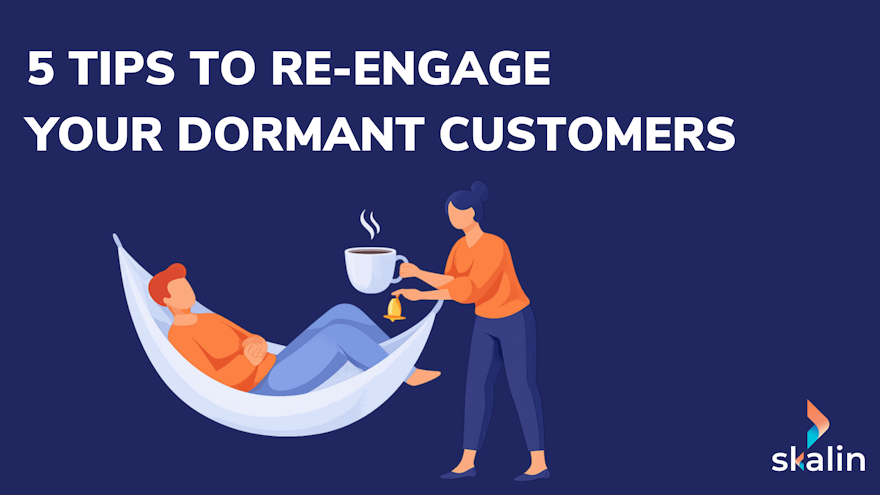
Dormant customers are every CSM's nightmare. They don't respond to your outreach, don't start conversations with you and no longer use your tool. Here's how to win them back without being heavy-handed.
First of all, you need to tell 'dormant' customers apart from 'quiet' customers. They look very similar, and the levers for re-engaging them are often the same.
There is, however, one big difference between the two, which affects how you prioritise and manage risk:
- The quiet customer still uses your platform, perhaps not in the best way, but they're still showing interest
- The dormant customer, on the other hand, neither talks to you nor uses your platform. Warning: an at-risk customer, with a health score heading into the red!
1. Adapt your approach to the customer's context
With these customers, even more than with others, it's important to talk about them, not about you and your platform. Your one-to-one outreach should be built around their challenges and pain points.
- During adoption
Customers can drift into dormancy soon after onboarding. In that case, it makes sense to go back to why you started working together. This is where the quality of the handover between sales and the Customer Success team really matters. Why did the customer buy your solution? Which challenge was it meant to address?
Your opening message should build on the pain points identified during pre-sales. They're unlikely to have gone away since!
- During the run phase
If, on the other hand, your customer goes quiet after several months of use, you need to build on what you know about them. Customer Success has gathered information during the previous stages and has probably set goals. Your reason for getting in touch should follow on from previous conversations and show continuity.
Your customer needs to feel the topic concerns them: that's how you'll spark interest and get a conversation going.
A message that's too generic, based only on your own benefits or suggesting a check-in meeting with no clear purpose, will come across as impersonal, and they won't feel it's aimed at them.
2. Personalise content for your audience
The bigger your customer portfolio, the more important it is to make your work scalable, which means sending messages at volume. Alongside your one-to-one work, you can strengthen your approach with one-to-few outreach through digital engagement with your users.
That doesn't mean giving up on personalised content, though. Qualifying and segmenting your customer base is the starting point for this kind of initiative.
To re-engage dormant customers, you'll need to share relevant, business-focused content tailored to your audience. An SME's concerns aren't the same as a large enterprise's. A marketing director in consulting doesn't respond to the same messaging as one in retail.
You'll need to tailor your campaigns to the different personas in your customer base and choose your angle, topic and keywords carefully. These customers have stopped using your platform, so they've probably forgotten the names of some features: promoting one of them will have very little impact. Your content should address their business challenges, while cleverly linking them to your solution and the benefits they can get from it.
The need to personalise and adapt content still applies if your portfolio is smaller and you work exclusively one-to-one.
With this kind of approach, it's worth watching how your quiet customers react. Do they 'consume' your content? Do they attend your webinars? If so, you can play down the risk associated with the fact that they don't talk to you.
One last point about your dormant customers: when you contact them by email, don't overlook the subject line and the structure of your message.
Remember that you're addressing a customer who is showing a lack of engagement with your company. Your sender name alone won't be enough to get them to open your email. Try out different types of subject line, and don't be afraid of bolder hooks. After several unsuccessful attempts, you could try a subject line such as 'Reassigning your licence'. You may well be surprised by the replies! It might be your chance to discover that they only use part of your offering, such as reading your newsletters or dashboards.
You can then seize the opportunity to secure the renewal by adapting the offer to how they actually use it, or realise that a new offer needs to be created!
As for structure, favour conversational emails with a clear goal that can be skimmed, with 120 words at most.
3. Vary your contact channels
We tend to favour email and send more and more of them to try to start a conversation and, ultimately, get a meeting with our customer. It seems a quick and simple channel, but be careful not to over-contact someone who is already losing interest: it could have the opposite effect to the one you want. When you're dealing with a dormant customer and your highly personalised emails aren't working, why not try the phone?
Opportunistic outbound calls can be very effective. These are your customers: you have their direct line and maybe even their mobile number, so it's perfectly legitimate to try to reach them without a meeting being booked. This channel takes a bit more effort, because it will probably take several attempts (I wouldn't necessarily leave a voicemail, as they probably won't call back), and you'll need to prepare your pitch while allowing for a touch of improvisation you don't get with email (try withholding your number as a last resort).
You can also try video messages embedded in your emails. Used sparingly, they spark interest and make your outreach feel more human. Going a step further, LinkedIn and SMS are also worth trying. Personally, I find the first very prospecting-oriented and not necessarily more effective than a traditional channel, and the second needs to be used carefully. Texting a dormant user you've never contacted this way before can come across as overly familiar. SMS is still widely seen as a close, personal channel. If your customer is dormant, it's because you haven't managed to build that kind of relationship. But if your customer journey includes this channel from the start, go for it!
One last tip: don't hesitate to change who makes contact on your side. Let another CSM try, or have your sales director send an email.
4. The contract signatory can be a real lever
CSMs often focus their efforts on users, because that's the very essence of the role. However, the person who signed the contract should be involved in achieving goals through the use of your platform. To prevent customers from going dormant, it's essential to agree on milestones, goals and a meeting cadence from the start of the contract, to secure the roll-out of your tool.
Your partnership should be part of their day-to-day work: you need to be embedded in their organisation and seen as a partner. If that's not the case, or if someone else is the day-to-day operational contact, the signatory is a lever to pull.
We started by asking how to win customers back without being heavy-handed. This is where that risk is greatest, so the way you word your message is critical. You need to be factual about the issue and about your unsuccessful attempts. Even if you know for certain that your user is still in their job, there's nothing to stop you asking whether they are, since you're surprised not to have heard back when you'd talked about making progress on certain challenges (here again, it's important to build on what you know about the customer).
With a quiet customer, it can be worth highlighting their usage to the signatory and involving them in setting up a check-in with the user. You can tell them you haven't had a chance to speak for a while (this time without mentioning that the user isn't responding to your messages).
5. Time is precious, so assess the risk
Re-engaging a dormant customer takes a lot of effort. If the different levers don't work, you sometimes have to accept it and move on. It's not unusual to find out afterwards that a reorganisation was under way, that the customer lacked maturity or that your contact had changed: all factors beyond your control. That's the harsh reality of our job: you can't have a churn rate of zero, and thinking you can is wishful thinking.
Depending on the levers you've already tried and the revenue the customer generates, it's often wiser to know when to stop. That way, your CSMs can focus on customers with higher value for your business.
BONUS. Keep iterating!
Managing your activity well also means constant analysis. Do your dormant customers have anything in common? At what point do they disengage? Do you need to strengthen your onboarding? Answering these questions can help you spend less time fixing problems and more time preventing them!
Further reading:
- 8 signs your customer is disengaging (even if they say nothing)
- How to use automated Playbooks to scale your Customer Success
- Your champion is leaving: what's the CSM's action plan?
- Customer offboarding: how to handle a customer's departure well in SaaS
- 5 steps to engage your customers for the long term