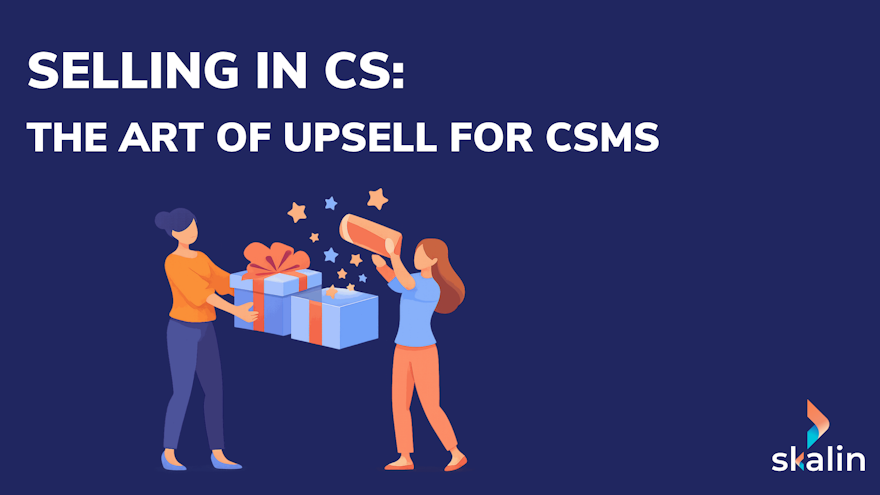
First things first, let's tackle one of CSMs' biggest worries head-on: selling isn't a bad thing! One common fear is damaging the relationship you've built with your customer. But it's possible to "sell well" without any negative impact on the rest of your relationship. Here's how.
Customers don't buy a product or service, they buy a benefit
A sale is an agreement under which the seller undertakes to deliver a product or service and the buyer undertakes to pay for it. It's a logical, rational agreement: a mathematical equation, with variables, that needs solving.
In any sale, there are questions you ask yourself:
- Who's buying?
- Who uses the service?
- How much am I going to sell?
- At what price am I selling the solution?
- How long will the contract last?
- And so on.
But even though these terms are written into the contract, they're not what your customer is buying. The questions above are centred on you, whereas the customer's first question is what they'll gain, which is the other side of the equation.
So, at the risk of disappointing you, your customer doesn't buy because they like you or because you're nice. They buy because there's something in it for them.
The good news is that the framework of your sale isn't limited to the contractual terms. Above all, it rests on what your customer stands to gain.
A CSM's sales equation is different from a salesperson's original equation
Promised value vs. delivered value
The initial sale is made on a promise of value, with the customer hoping for gains. After that initial sale, the aim is to deliver the expected gains so as to fulfil the original promise of value.
A CSM's sale, on the other hand, takes place when you already have a history of working together.
As the CSM follows the customer's transformation project, they need to measure the customer's perception of performance frequently. There may be a gap between the performance your solution delivers and what your customer perceives. If they don't fully see what is actually being delivered, your customer risks being disappointed with the level of performance over time, which increases the risk of churn.
Conversely, if the customer perceives the performance at its true value, you have fertile ground for expanding usage. Thanks to your project tracking metrics, you'll have tangible, measured and objective facts to build your arguments on, giving you a solid framework for the discussion.
The aim is to centre your sale on gains, not on contractual variables.
The timing of your sale is also different from a salesperson's. The current contract provides the framework for the sale: you're not starting from a blank page, but from a contract that's already signed. So the sale has a fixed timeframe: both parties know the contract end date. The advantage is that you can plan and gradually move through the stages of your sale.
Help your customer picture future value
At the start of the contract, there was "expected value". During the contract, there's "delivered value". And for your sale, there's a third kind: "projected value".
To sell successfully as a CSM, you mustn't use current value as your only argument, otherwise you'll struggle to upsell and take the customer further in how they use the product.
The value already delivered is the foundation for engaging your customer in a forward-looking phase, where you can put forward future scenarios with new gains: that's "projected value".
By doing this, you're no longer justifying the present, you're imagining the future, and that changes the whole dynamic of the conversation and the sale.
Selling in Customer Success: best practice
Managing timing
To save time, you might be tempted to email your commercial proposal, but you'll lose the initiative in the sale. Your customer has what they wanted (the terms of the proposal), and that puts you in a passive, wait-and-see position.
- Your sales pitch should build gradually
- Never email a presentation without presenting it first
- Never email a commercial proposal either: present and defend it in a meeting.
Avoid losing touch. "OK, I'll let you call me back" is an example of a sentence with no clear deadline: you're at the mercy of the other person's goodwill to call back whenever they feel like it. That's uncomfortable for you, because you're no longer in control of the timing of your sale.
Agree a clear next step, shared in both diaries.
"Yes" isn't enough. A sale is won when the signed contract is in your inbox. A verbal agreement or a simple email saying yes doesn't count.
The right stance
Stay on course
- Know how to say "no". A contract involves two parties: you have your say on the terms of sale
- Use the same message with every customer
- Have big ambitions with every customer
Be confident in the merits of what you're selling.
Listen to your customer.
Rephrase what you hear.
Don't interpret: use factual information.
Follow a negotiation process that maps out the key stages. On this point, CSMs need training in negotiation strategies, stances, techniques and so on. Being a good negotiator isn't an innate gift: it can be learnt, and anyone can become a good negotiator.
Don't try to sell: make them want to buy.
Key takeaways
- Selling won't damage your relationship with your customer.
- Without a sale, there's no mutual gain.
- Focus your conversations on gains.
Further reading:
- Customer Success: turning the customer relationship into a revenue engine
- How do you get Sales and Customer Success working together effectively?
- Improving retention and upsell in B2B SaaS: tips and best practices
- How do you generate more leads with a referral strategy?
- How do you become the trusted advisor your customers are looking for?