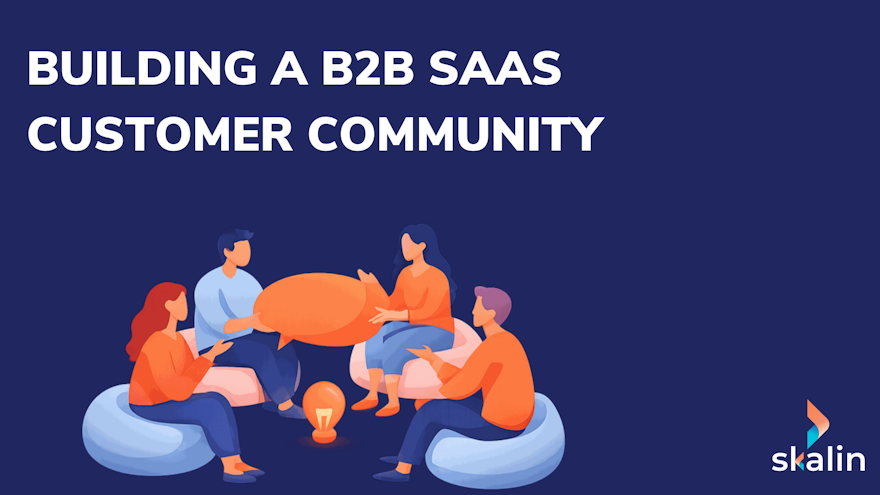
Six months ago, you opened a Slack workspace for your customers. In the first few days, everyone introduced themselves, your CEO posted enthusiastic messages and two or three users were already swapping tips. Three weeks later: nothing. The last post is about the latest release, shared by your Product Manager, with zero reactions. You can't simply declare a customer community into existence. You have to build it and keep it going. Here's how to get yours off the ground!
Customer communities are all the rage in B2B SaaS, and it's easy to see why. On paper, they tick every box: customers who help each other (and take pressure off your support team), share how they use the product (and improve adoption), tell you what they need and end up recommending you. A retention machine, in short.
So let's be clear from the outset: opening a space for conversation won't magically reduce your churn. A community is a real lever, but it's a product in its own right. It needs a goal, an owner, a rhythm and metrics. Without them, it fizzles out.
What a customer community really brings
Let's start with the most important point: your customers don't join your community for you. They join for each other. A Head of Sales wants to know how another Head of Sales set up their reports; an HR manager wants to see how their peers rolled the tool out to 400 employees. That peer-to-peer experience is something neither your CSM nor your documentation can provide.
That's exactly what Nisha Baxi, Director of Community at Gong, explained during a webinar run by MeltingSpot: what first motivated the company's customers was the chance to talk to other users facing the same challenges.
What you can expect from it
When it works, a customer community has several very concrete effects:
- Peer support: simple questions get answered by other users, often with hands-on experience you don't have.
- Learning by example: best practices, shortcuts and use cases that neither you nor the customer had thought of.
- A knowledge base that grows by itself: every resolved thread becomes a resource for the next person.
- More contacts per account: users your CSM never sees in meetings become visible, and sometimes become drivers.
- An ongoing voice of the customer: pain points, needs and ideas surface without waiting for the next business review.
- Advocates: customers who champion your product in public, and take it with them when they change companies.
That last point is often underestimated. People move around a lot in SaaS, and a satisfied user you met in your community may, two years later, be the one who recommends you for your next big deal. That's the whole point of a well-designed referral strategy: a community is its natural breeding ground.
What it isn't
A community isn't a cut-price support channel. If your customers post blocking bugs there and wait three days for an answer, you're not cutting costs: you're publicly exposing how slow you are.
It isn't a marketing channel either. If 80% of the messages are your product announcements and webinar invitations, you've created a newsletter with comments switched on. Nobody comes back for that.
Above all, be careful with the figures you're shown. Do the most active customers in your community churn less? Very probably. But they're also, quite often, the ones who were already the most engaged with your product. A community strengthens existing engagement far more than it creates engagement from scratch. Correlating participation and retention is useful, as long as you don't confuse correlation with proof. This is where a lot of teams tell themselves stories!
Start with the "why" (and pick just one)
Setting goals is the very first step: the "why" determines who can join the community, what content to share there and which features you need. The trap is trying to do everything at once.
The main possible goals are quite distinct:
- Peer help and support: getting answers to flow between users.
- Adoption and upskilling: helping customers make better use of the product.
- Professional networking: connecting professionals who share the same challenges.
- Product co-creation: involving customers in the roadmap.
- Advocacy: identifying and equipping advocates.
Why pick just one to start with? Because each one needs a different format, different hosts and different metrics. A product co-creation community will be small and selective, run by your Product Managers. A networking community will thrive on events and discussions that go well beyond your tool. Mixing the two from the start means building a space that doesn't really speak to anyone.
Once you've set the goal, make it visible. HubSpot states the promise of its community clearly on the home page: connect with peers, deepen your mastery of the tool and learn to grow better. Visitors immediately know what they're there for.
Do you have critical mass?
It's the question nobody asks before launching their Slack. Yet an online community needs a minimum number of people to sustain itself (more on this below with the 90-9-1 rule). Work it out backwards: if you have 150 active users, expect, roughly speaking, around fifteen people who'll post from time to time and one or two regular contributors. That's not many. Not many at all.
Below a certain customer base size, an open forum risks feeling empty. In that case, it's better to start with more intimate formats: a user club, a customer committee, quarterly in-person meet-ups. You can widen it once your base allows.
What's specific to B2B
Keep three things in mind. First, your members are busy professionals: they'll only come if the community saves them time or helps them get better at their job. Second, some of your customers compete with each other, which calls for clear rules on what can be shared. Finally, the user who takes part isn't always the person who signs: your community will mostly reach hands-on users, rarely the executive sponsor.
Choose a format where your customers already are
One piece of advice: choose a platform your customers are already active on, or a tool built into your own platform. If your users live in Slack all day, a dedicated workspace is more likely to work than a forum they'll have to remember to log in to.
Each format has its strengths and limitations:
- Slack or Discord: very low friction if your customers are already there, but conversations are short-lived and hard to find again.
- A forum or dedicated community platform: content is structured, searchable and becomes a genuine knowledge base, at the cost of an extra login step.
- A community built into the product: with tools such as MeltingSpot, Bettermode or Gainsight Customer Communities, conversations appear directly in your interface. Zero friction for users, but an empty community becomes very visible.
- A LinkedIn group: instant access, but you control neither the visibility of posts nor the data.
- In-person events and user groups: the best way to build relationships, but hard to sustain at scale.
- A customer committee or advisory board: ideal for product co-creation, but by definition limited to a handful of accounts.
In practice, the tool is the last question to settle, not the first. Many B2B communities that work combine an online space for day-to-day exchanges with in-person meetings to build relationships. Don't spend three months comparing platforms before checking that your customers actually want to talk to each other.
Launch: never open the doors to an empty room
Mehdi Hussen, a SaaS marketing and GTM consultant, uses a telling image: running a community is like throwing a party, and nobody wants to turn up to a party where they don't know anyone. Hence his advice to start with your earliest customers, the ones who trusted you early on and are your best advocates.
In practice, your launch cohort comes from:
- regular users of your product;
- customers who recommend you on review sites or social media;
- those who send you feedback and suggestions;
- those who engage with your content;
- those with an audience in your ecosystem.
Then prepare the ground before you open. A few conversations already started, frequently asked questions already answered, templates shared: the first visitor should find something to engage with, not a blank page. And favour a personal invitation from the CSM over a mass email: it's far more effective.
The best time for that invitation? Often the end of onboarding, when the customer has seen their first results and is starting to wonder how to go further.
Keeping it going: where it all happens
Launching a community is easy. Keeping it alive in month four, once the novelty has worn off, is another story. That's what separates the communities that last from those that fade.
Accept silent members
In 2006, Jakob Nielsen formalised what he called "participation inequality": in most online communities, 90% of members watch without ever contributing, 9% contribute a little and 1% generate most of the activity (source). The proportions vary by context, but the pattern is remarkably stable.
Don't see it as a failure. A customer who reads without ever posting still gets value from your community, so don't judge its health on the number of messages alone. That 1% of contributors, however, is your most valuable asset: look after them.
Always reply quickly
A question that goes unanswered for several days sends a terrible message to everyone who sees it: nobody's listening here. Set up an internal rota, identify the experts to call on for each topic, and set yourself a first-response time. Even "good question, I'm checking with the Product team" beats silence. Never let the void set in.
Create rituals
A community thrives on regular events. A few formats that work well in B2B:
- A Q&A session with a Product Manager or subject-matter expert.
- Office hours where your CSMs answer usage questions live.
- A theme of the month to steer the conversations.
- A customer story presented by the customer themselves.
- Members-only webinars.
The frequency should be optimal, not maximal. A monthly event kept up for two years beats a weekly rhythm abandoned after six weeks.
Let customers do the talking, not the brand
The real sign of health is when conversations no longer go through you. To get there, ask questions rather than making announcements, showcase how your customers use the product and hand them the reins. At Gong, according to Nisha Baxi, the team encouraged its most enthusiastic members to organise meet-ups themselves, with a very clear effect on engagement.
Recognise contributions too. Zapier, for example, awards badges when a member reaches a milestone or gives the best answer. Early access to new features, an invitation to speak at an event, certification: in B2B, professional recognition often motivates people more than swag.
Close the feedback loop
Your community will generate requests, lots of requests. If they disappear into what CS teams call the feedback "black box", customers will stop speaking up. And they'll be right to!
Show what has been taken on board, be clear about what won't be, and when a feature ships, publicly thank those who asked for it. Nothing builds loyalty like seeing your suggestion become reality.
Set ground rules
Finally, set a framework from the start: no prospecting between members, respect for confidentiality (especially if competitors rub shoulders), moderation of conversations. Clear rules reassure people more than they hold them back.
Who owns the community?
This is often where the project goes off the rails. Marketing knows how to run things and produce content, Product holds the expertise and the roadmap, and Customer Success knows the customers and owns the retention goals. The result: everyone is a bit involved, and nobody is accountable.
If your community's goal is adoption and retention, Customer Success should co-own it. CS knows which customers to invite, which pain points to address and how to connect community activity to account health. But Product must be present, visible and responsive, or the community loses its main added value.
Be careful, though, not to make it a side project for a CSM who already manages 80 accounts. A community needs time every week, consistently. If nobody has that time in their diary, it's not the right moment to launch.
That's particularly true for your low-touch segment. For customers you can't support one-to-one, a well-run community is one of the few channels that scales without dehumanising the relationship. Provided, of course, that someone really runs it.
Measure what really matters
The number of sign-ups is the most flattering metric and the least useful. It says nothing about the value created. Here's what to track instead.
Community health:
- the ratio of members active in the last 30 days to registered members;
- the average time to first response;
- the share of questions resolved;
- the share of answers given by other customers rather than your teams.
Business impact:
- the share of your customer accounts represented in the community;
- the average number of members per account;
- adoption of the features discussed or presented;
- retention and expansion of member accounts, compared with accounts of a similar profile.
That last point deserves a closer look. Bluntly comparing member and non-member accounts means falling back into the bias mentioned earlier. Compare accounts of similar health, size and tenure, and you'll get a much more honest idea of your community's real effect.
Finally, make sure community activity shows up in your CSMs' customer view. A champion who suddenly stops taking part is a weak signal not to ignore. Conversely, finding three very active users in an account where you only had one contact is a golden opportunity to stop the relationship depending on a single person.
Conclusion
A customer community isn't just another channel to tick off in your strategy. At heart, it's your customer relationship at scale: customers who talk to each other, learn from each other and talk to you all the better for it.
But you'll only get out what you put in. If you remember one thing: start small, with a single goal, around twenty well-chosen customers, a named owner and a ritual you're certain you can keep up. Then expand at the pace your members ask for. And give yourself at least six months before judging. The communities that last are rarely the ones that started strongest; they're the ones that never stopped!
Further reading
- The "5-year customer" model: aligning the whole company around retention
- 5 steps to engage your customers for the long term
- Digital Customer Success: from firefighting to strategic efficiency
- How do you generate more leads with a referral strategy?
- Why your low-touch segment deserves a real strategy (and how to build one)