
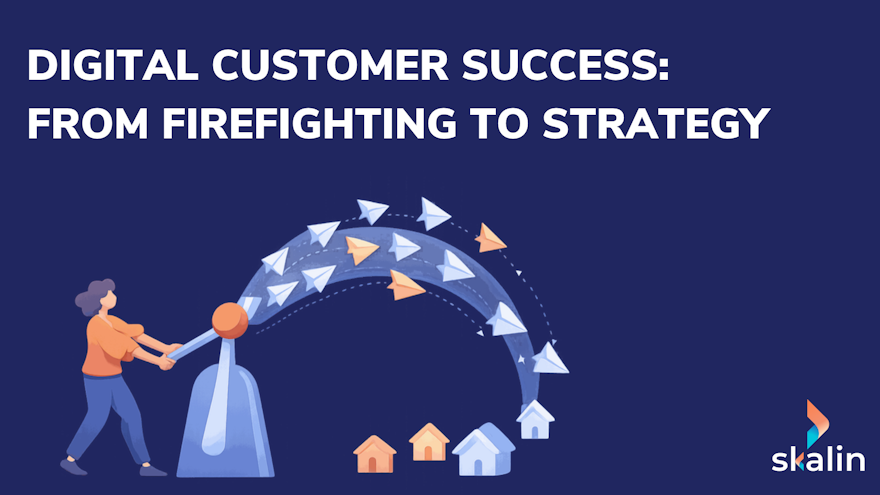
Overloaded, reactive and sometimes close to burnout, Customer Success Managers (CSMs) struggle to balance closeness to customers with strategic oversight. What if digital were the answer? Digital Customer Success isn't just a set of tools: it's a new approach that rethinks priorities, automates the operational work and gives teams back the time and headspace to create real value.
Steering committees, strategic calls, renewals, upsells... Today more than ever, the CSM role sits at the heart of customer strategy. CSMs drive retention, spot growth opportunities and smooth the relationship between customers and the company. In short, the CSM has become the conductor of customer satisfaction.
But there's a catch. Behind these high-value responsibilities there's often another, far less glamorous reality: repetitive, time-consuming tasks that often have little business impact.
Spending three hours preparing slides for a steering committee, manually chasing a customer to fill in a survey, hunting for a piece of customer data across four different tools: all these micro-tasks eat into CSM teams' time and energy.
So how do you get out of this operational dead end and give your teams some breathing space? Digital CS isn't a silver bullet, but it's a powerful lever if you use it well.
Start with the right diagnosis: audit day-to-day tasks
Before you talk about automation, you first need to know where time is being lost.
1. Take stock
Start by auditing what your CSMs do every day. List every task, even the most trivial. This inventory often reveals a host of activities that never show up in official reporting.
2. Link each task back to the CS team's objectives
For each activity on the list, ask yourself a simple question: which strategic objective does this task contribute to?
- Customer satisfaction
- Loyalty / retention
- Upsell & cross-sell
- Product adoption
- Customer data quality
If a task doesn't feed any of these objectives, it's fair to ask whether it really needs doing.
3. Identify low-value tasks
Some tasks, while aligned with the objectives, take up a disproportionate amount of time. That's where optimisation gets interesting.
For example: attending a 60-minute customer committee is useful. Building 40 slides by hand every time isn't necessarily.
Bring in strategic prioritisation
Not all automations have the same impact. Before you start, it's worth ranking tasks by two criteria: how often they happen and their business impact.
- Frequent, low-value tasks are the first candidates for automation.
- Occasional, high-value tasks are often worth keeping manual.
This approach maximises the return on your digitalisation efforts.
Automate intelligently (not indiscriminately)
Automation only adds value if it's built on a process that has already been proven manually. Automating a shaky process risks amplifying what's broken.
1. Formalise your workflows
Before you digitalise, map out your processes. Who does what, when, with which data and which tools? A simple diagram is often enough to bring the friction points and repetitive tasks to light.
2. Start small
The classic mistake: trying to automate everything in one go.
Start with a few quick wins:
- Automatically sending certain customer emails through marketing automation
- In-app messages at key moments in the customer journey
- Automatically pre-filling some internal reports using data
It's always easier to add building blocks than to dismantle an over-engineered machine.
3. Work as a team with other departments
Your CS team doesn't operate in isolation. Marketing, Product and Data can be your best allies:
- Marketing can run automated onboarding sequences
- The Product team can build proactive notifications directly into the solution
- The Data team can provide CSMs with highly relevant real-time dashboards
Bring the voice of the customer into digitalisation
Digitalisation shouldn't be driven solely by the company's internal view. Asking customers for their input regularly helps you understand their need for autonomy, their current pain points and what they expect from self-service.
A few useful tools:
- Targeted NPS and CSAT surveys
- Customer interviews
- Analysis of support tickets and the most-viewed FAQs
This active listening ensures digitalisation stays aligned with the customer experience people expect.
Classic mistakes to avoid
- Automating before clarifying the process: digitalising a fuzzy process just automates the chaos. Before any automation, every step needs to be defined and documented.
- Trying to automate everything from the outset: overly ambitious projects risk becoming over-engineered. It's better to start with simple automations that are quick to set up.
- Underestimating the support CSMs need: effective automation isn't just about tools, it's also a change in how people work. Training CSMs and involving them in designing the journeys is essential.
- Forgetting customer feedback: digitalisation mustn't harm the customer experience. Poorly calibrated automations can frustrate customers. Always check the impact on customers beforehand.
- Skipping a pilot phase: every automation should first be tested on a small sample before a wider roll-out. That lets you fix problems at lower cost.
Treat automation as a living project
A good digital journey isn't something you set up and forget; it needs ongoing care.
Your customers' needs change, your product changes, and so does your team. An automation that's relevant today could be obsolete tomorrow if you don't adjust it regularly.
Hold regular reviews:
- Are the target KPIs being met?
- Have operational irritants decreased?
- Are customers genuinely becoming more self-sufficient?
Don't hesitate to draw inspiration from best practice in the market. Test, adjust, simplify. It's the only way to gradually find the formula that fits your context.
The real goal: refocus your CSMs on value
The end goal isn't to replace CSMs, but to let them focus where they create the most value:
- Strategic accounts
- Key moments in the customer lifecycle
- Highly complex situations
"Every hour saved through automation is an hour given back to the customer relationship."
In short, digital isn't a threat to the CSM role. Quite the opposite: it's the essential ally that lets you absorb growing customer portfolios without sacrificing the quality of the customer experience.
Further reading:
- Why your low-touch segment deserves a real strategy (and how to build one)
- 15 Essential Customer Success Playbooks
- Automating Customer Journeys: lessons from Karnott
- Small accounts, big impact: 7 automated workflows to transform your low-touch customer experience
- AI jargon explained for Customer Success Managers